
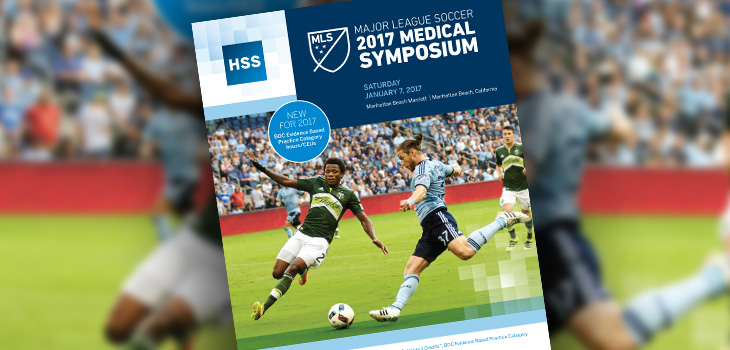
On January 7, 2017, Hospital for Special Surgery (HSS) and Major League Soccer (MLS) hosted the 2017 Major League Soccer Medical Symposium in Manhattan Beach, California. This symposium brought together the nation’s top sports medicine professionals to discuss managing athletic injuries specifically in soccer players.
HSS, MLS Host Medical Symposium
1 min read Premium comments
Secondary
The course reviewed current recommendations, techniques and protocols for: cardiac arrest, spinal cord injuries, acute heat stroke and concussions. Additionally, participants learned about the pathology of emerging diseases (such as Zika), saw new research on synthetic playing surfaces and review preparation and recovery techniques.
Among the other speakers included were Kurt Andrews, assistant athletic trainer for Los Angeles Galaxy, George Chiampas, chief medical officer for U.S. Soccer, John Gallucci Jr., medical coordinator for Major League Soccer, and Bert Mandelbaum, M.D., FIFA medical officer Rio Olympics 2016.
Patrick Vignona, PT, MSPT, SCS, Cert MDT, clinical specialist at HSS, told OTW, “There were many highlights at this year’s symposium. To name a few, we did a review of infectious disease and concussion management for players. We also went over new guidelines for handling the heat and cold weather. Another hot topic was discussing whether or not artificial turf is safe to play on.”
“We are learning that the research does not support that artificial surfaces (such as turf) does not increase the players’ risk of injury which is contradictory to what the players think and feel.”
“There needs to be continued research of ground reaction forces and how they differ between artificial surface and natural grass.”
Author
React:
Discussion
This is a fascinating development. In my practice we've seen similar outcomes with the revised protocol. The key differentiator seems to be patient selection criteria. Has anyone else noticed the correlation with BMI thresholds?
Great point. I'd push back slightly on the conclusion, the sample size in the cited study is too small to draw population-level inferences. That said, the directional signal is compelling and worth a larger RCT.
We implemented a similar approach last year. Early results are promising but we're still gathering 12-month follow-up data. Happy to share our protocol if anyone is interested.
Join the conversation
Orthopedic professionals are discussing this. Sign in and upgrade to read every comment and add your voice.