
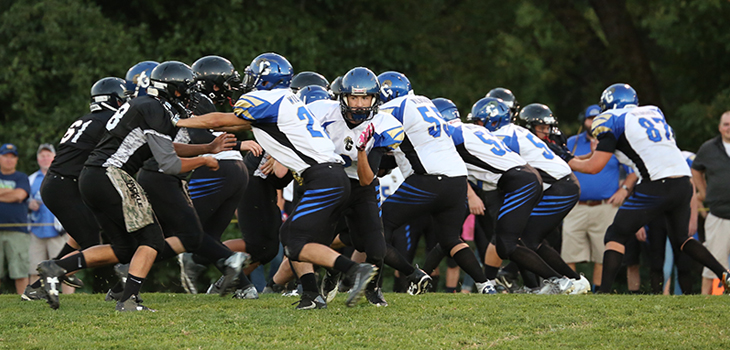
The long-term health of men who played high school football has been unaffected by that high impact sport according to a recent study by researchers at the Mayo Clinic, Rochester, Minnesota. As reported by Dan Gray, writing for Healthline News, playing varsity-level high school football does not carry an increased risk of neurodegenerative diseases compared with other varsity-level sports.
High School Football OK to Play Says Mayo Study
1 min read Premium comments
Secondary
Researchers analyzed the long-term health of 486 student athletes who had played high school sports between 1956 and 1970—296 had played football and 190 had competed in other sports. Students in both groups experienced head trauma, mild cognitive impairment, Parkinson’s disease and dementia but playing football did not appear to carry a significantly higher risk.
But there was a risk. The percentage of former student athletes who experienced head trauma was slightly higher among those who had played football (11% vs. 7%). “It’s somewhat reassuring, ” said Gregory Landry, M.D., a pediatric and adolescent primary care physician from the University of Wisconsin School of Medicine and Public Health. He noted the small sample size and the fact that football has changed a great deal since the ’50s and ’60s.
Landry says that present procedures are a marked contrast to the way concussions were treated in the past.
“I don’t think we recognized that some of these relatively mild head injuries were indeed concussions and that when that happened, a player shouldn’t be in the game, ” he told Gray. “I think that players, coaches, and parents are recognizing concussions much more readily. Any impairment in mental function after a head bonk is a concussion, and athletes should not be practicing or playing if they’re impaired in any way.”
Author
React:
Discussion
This is a fascinating development. In my practice we've seen similar outcomes with the revised protocol. The key differentiator seems to be patient selection criteria. Has anyone else noticed the correlation with BMI thresholds?
Great point. I'd push back slightly on the conclusion, the sample size in the cited study is too small to draw population-level inferences. That said, the directional signal is compelling and worth a larger RCT.
We implemented a similar approach last year. Early results are promising but we're still gathering 12-month follow-up data. Happy to share our protocol if anyone is interested.
Join the conversation
Orthopedic professionals are discussing this. Sign in and upgrade to read every comment and add your voice.