
The public is going to get information on recalled medical devices a little quicker in 2017. The FDA announced on January 3, 2017 that the agency is posting device recall information on its website earlier than in previous years.
FDA Speeds Up Device Recall Postings
2 min read Premium comments
Secondary
The FDA used to post device recall information only after the agency announced the company’s initiation of a correction or removal action. Now, the agency is posting the information on the Center for Devices and Radiological Health’s (CDRH) Medical Device Recalls Database at the time the company takes a correction or removal action and notifies FDA that it can post the information, rather than at the time of FDA’s recall classification.
So far, there has only been one recall in 2017. Nurse Assist Inc. recalled the normal saline flush syringes due to incidents of Burkholderia cepacia (B. cepacia) contamination. B. cepacia is a bacterium that can cause bloodstream infections, particularly in patients with weak immune systems.
The FDA issued 39 device recalls in 2016, which was more than the 32 recalls from 2015 but significantly less than the 60 recalls from 2014.
The last recall of 2016 was an orthopedic device use during hip replacement surgeries. Greatbatch Medical recalled its Standard Offset Cup Impactor with a POM-C handle that failed sterility testing when sterilized in a dedicated instrument case. Non-sterile surgical devices can lead to infections, and other serious adverse health consequences, including death.
In a written statement, the agency said, “The process and timelines for reporting a correction or removal will not change. Please continue to work with your District Recall Coordinators. When you provide the required information, your district recall coordinator will ask whether the information is ready to be posted. If you agree, the FDA will post information regarding the correction or removal action in the searchable Medical Device Recalls Database and in the OpenFDA Device Recalls API. We will update the Medical Device Recalls Database and the OpenFDA Device Recalls API after the recall is classified and again when it is terminated.”
The agency may also post company press releases or other public notices about recalls, market withdrawals and safety alerts that may potentially present significant risks to consumers or users of the product.
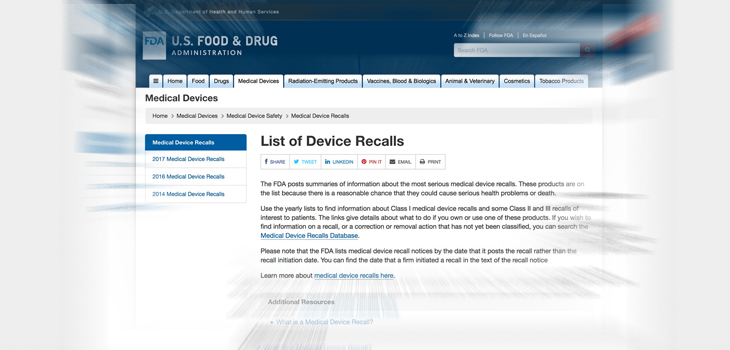
Use the yearly lists to find information about Class I medical device recalls and some Class II and III recalls of interest to patients. The links give details about what to do if you own or use one of these products. If you wish to find information on a recall, or a correction or removal action that has not yet been classified, you can search the Medical Device Recalls Database.
Please note that the FDA lists medical device recall notices by the date that it posts the recall rather than the recall initiation date. You can find the date that a firm initiated a recall in the text of the recall notice.
Author
React:
Discussion
This is a fascinating development. In my practice we've seen similar outcomes with the revised protocol. The key differentiator seems to be patient selection criteria. Has anyone else noticed the correlation with BMI thresholds?
Great point. I'd push back slightly on the conclusion, the sample size in the cited study is too small to draw population-level inferences. That said, the directional signal is compelling and worth a larger RCT.
We implemented a similar approach last year. Early results are promising but we're still gathering 12-month follow-up data. Happy to share our protocol if anyone is interested.
Join the conversation
Orthopedic professionals are discussing this. Sign in and upgrade to read every comment and add your voice.