
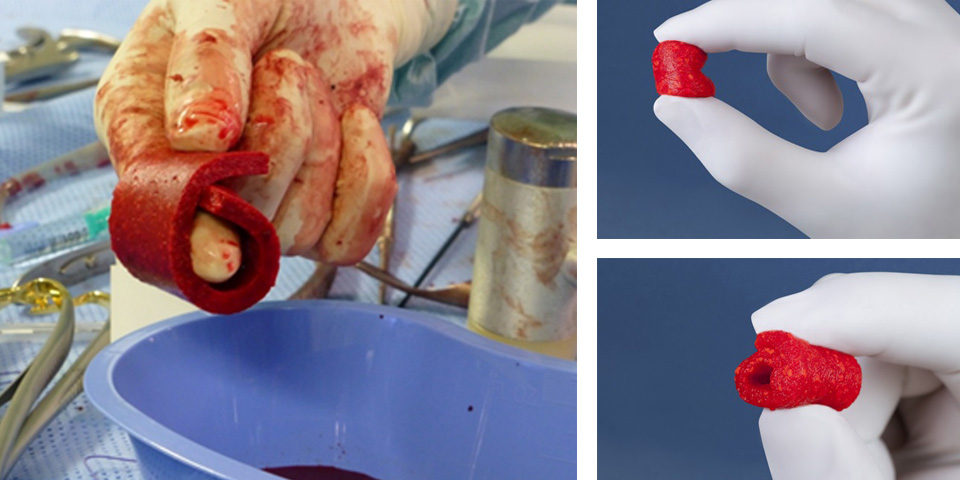
CERASORB Ortho FOAM, a novel form of bone void fill developed by curasan AG, a former Riemser Inc. subsidiary, received approval this past December for commercial sale from the United States Food and Drug Administration (FDA).
FDA Approves Novel Bone Foam
1 min read Premium comments
Secondary
CERASORB Ortho FOAM, an innovative new bone void fill, is made with a resorbable ceramic and porcine collagen. This novel combination allows the foam to be assimilated by the body as bone.
In a December 6, 2016 press release curasan AG CEO Michael Schlenk said of the FDA action: “Even before the approval, major customers indicated during exploratory discussions that the flexible and moldable version of CERASORB meets the demands of the U.S. customers perfectly, much more so than any of our other products.” Schlenk went on to speculate that the global synthetic bone material has the market value of more than $900 Million.
The U.S. company is based out of Research Triangle Park in North Carolina. In 2004 it was purchased by the German pharmaceutical company Riemser Incorporated. After a period of struggle in the U.S. market, curasan was able to repurchase the rights to its product line in 2013. Now, with the FDA’s approval of CERASORB Ortho Foam, the company is prepped for the challenge and opportunity of U.S. commercialization.
“We have plans to expand throughout the next several years, including some staff within North Carolina, but more growth will be coming in our number of sales representatives elsewhere throughout the U.S. and Canada.” – curasan Inc. U.S. subsidiary President Shane Ray.
According to Ray, curasan Inc. will focus on expanding into the orthopedic production. Before this the company was principally focused on serving the dental market. But, as Ray noted, broadening the company’s focus to general orthopedics, trauma, spine and other indications for bone void fill, increases the company’s potential significantly.
Author
React:
Discussion
This is a fascinating development. In my practice we've seen similar outcomes with the revised protocol. The key differentiator seems to be patient selection criteria. Has anyone else noticed the correlation with BMI thresholds?
Great point. I'd push back slightly on the conclusion, the sample size in the cited study is too small to draw population-level inferences. That said, the directional signal is compelling and worth a larger RCT.
We implemented a similar approach last year. Early results are promising but we're still gathering 12-month follow-up data. Happy to share our protocol if anyone is interested.
Join the conversation
Orthopedic professionals are discussing this. Sign in and upgrade to read every comment and add your voice.