
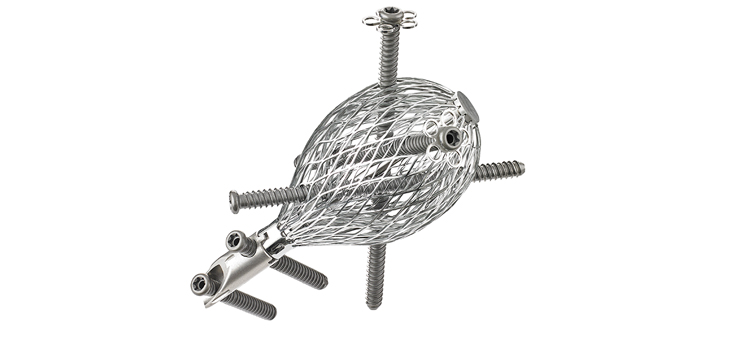
Conventus Orthopaedics, Inc. has announced that over 700 patients have been treated with what is the industry’s first expandable fracture cage. The Conventus Cage, meant for fracture repair in the upper extremity, utilizes a 3-dimensional approach and is made of nitinol.
Conventus Milestone: Over 700 Patients With Expandable Cage
2 min read Premium comments
Secondary
“For years, surgeons have expressed the need for more versatile and reliable surgical options to repair simple to complex fractures, ” said company CEO Paul Buckman, in the December 19, 2016 news release. “The Conventus Cages expand what is possible in patient care by enabling surgeons to repair a wider variety of fractures through less invasive means.”
Andrew Schmidt, M.D., chief of Orthopaedics, Hennepin County Medical Center, added, “For especially problematic fractures, such as those in the proximal humerus, the results after Cage fixation seem to be better, with more rapid return of motion and a dramatically lower incidence of surgical complications.” Paul Paterson, M.D., orthopedic surgeon in Buffalo, New York added, “The Conventus Cage offers tremendous stability of the fracture—better than plates and screws—through the use of 3-dimensional fixation. These fractures just do not move post repair.”
As indicated in the news release, “Conventus’ 3-dimensional Cage platform technology, emphasizes preservation of tissues and blood supply at the fracture site, creating a strong foundation by stabilizing bone fragments and facilitating early motion through less invasive procedures.”
David Blue, chief commercial officer at Conventus, told OTW, “It was when we realized that we had something even much more special than what we thought, when we were simply solving the varus and valgus collapse in proximal humerus fractures. It was when this truly became a complete 3-dimensional approach to treating fractures, and a fragment specific fracture management system. Being able to give surgeons the ability to treat all fracture types and specific fragments from a 360 degree approach, while being able to allow surgeons to utilize their own desired surgical technique/approach, was going to be a significant advancement and improvement in the treatment of fractures.”
“Surgeons no longer need to shy away from proximal humerus fractures nor have the fear or concern of these failures that we have historically and consistently seen with these. They can now confidently and predictably fix those 2, 3, and 4 part fractures, knowing that the humeral head won’t collapse, and their screws won’t protrude through the head, no matter the age of the patient or the quality of the bone. The Conventus Cage system is not reliant or dependent on the quality of the bone or the comminution of the fracture. They can now leave the OR confidently knowing that their patients will leave having a very stable construct, and having the confidence in a predictable and positive outcome.”
According to the company, the Conventus Cage System now has five FDA cleared indications in the upper extremity and it is quickly moving into all the lower extremity applications as well.
React:
Discussion
This is a fascinating development. In my practice we've seen similar outcomes with the revised protocol. The key differentiator seems to be patient selection criteria. Has anyone else noticed the correlation with BMI thresholds?
Great point. I'd push back slightly on the conclusion, the sample size in the cited study is too small to draw population-level inferences. That said, the directional signal is compelling and worth a larger RCT.
We implemented a similar approach last year. Early results are promising but we're still gathering 12-month follow-up data. Happy to share our protocol if anyone is interested.
Join the conversation
Orthopedic professionals are discussing this. Sign in and upgrade to read every comment and add your voice.