
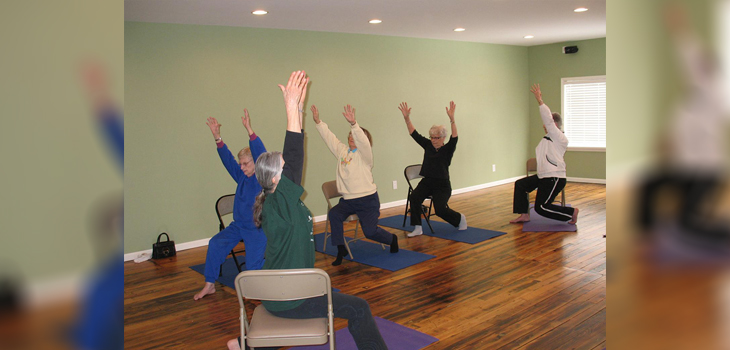
If you have osteoarthritis (OA), you may just have to go as far as, well, your chair, to get help. A new study, published in the current issue of the Journal of the American Geriatrics Society has found that chair yoga is effective at reducing pain and improving quality of life for those with OA in their lower extremities (hip, knee, ankle or foot). This research, undertaken by scientists from Florida Atlantic University (FAU), is the first randomized controlled trial to examine the effects of chair yoga on pain and physical function in older adults with osteoarthritis.
Chair Yoga Is Effective Treatment for OA
2 min read Premium comments
Secondary
As indicated in the January 11, 2017 news release, “For the study, researchers randomly assigned 131 older adults with osteoarthritis to either the ‘Sit ‘N’ Fit Chair Yoga’ program developed by [yoga teacher] Kristine Lee or a health education program. Participants attended 45-minute sessions twice a week for 8 weeks. Researchers measured pain, pain interference (how it affects one’s life), balance, gait speed, fatigue and functional ability, before, during and after the sessions. Results from the study found that participants in the chair yoga group, compared to those in the health education program, showed a greater reduction in pain and pain interference during their sessions, and that reduction in pain interference lasted for about three months after the 8-week chair yoga program was completed. The 8-week chair yoga program also was associated with reductions in fatigue and improvement in gait speed during the study session, but not post session.”
“With osteoarthritis-associated pain, there is interference in everyday living, limiting functional and social activities as well as diminishing life enjoyment,” said Juyoung Park, Ph.D., co-author and co-principal investigator of the study, Hartford Geriatric Social Work Faculty Scholar and an associate professor in FAU’s College for Design and Social Inquiry. “The effect of pain on everyday living is most directly captured by pain interference, and our findings demonstrate that chair yoga reduced pain interference in everyday activities.”
Dr. Park told OTW, “We are able to provide the chair yoga program as one of the effective and safe nonpharmacological pain management options for older adults with osteoarthritis. We have also presented our research findings to the patients, practitioners, and caregivers in the community so that they were able to learn about pain management and alternative therapies including chair yoga to manage osteoarthritis.”
“The chair yoga program shows some positive effects on clinical outcomes, including pain, pain interference, fatigue, and gait speed. Therefore, chair yoga, as an alternative and complementary therapy, could reduce pharmacological treatment, expensive joint replacements, and the need for assistance at home.”
React:
Discussion
This is a fascinating development. In my practice we've seen similar outcomes with the revised protocol. The key differentiator seems to be patient selection criteria. Has anyone else noticed the correlation with BMI thresholds?
Great point. I'd push back slightly on the conclusion, the sample size in the cited study is too small to draw population-level inferences. That said, the directional signal is compelling and worth a larger RCT.
We implemented a similar approach last year. Early results are promising but we're still gathering 12-month follow-up data. Happy to share our protocol if anyone is interested.
Join the conversation
Orthopedic professionals are discussing this. Sign in and upgrade to read every comment and add your voice.