
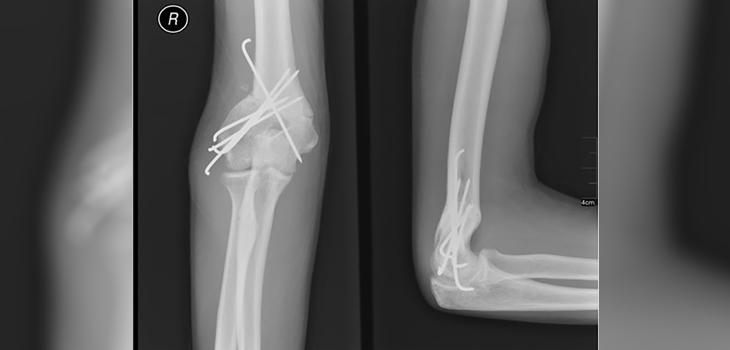
In a recent study published in the January issue of the Journal of Pediatric Orthopaedics, Paul D. Sponseller, M.D., professor of urology and orthopedic surgery at the Johns Hopkins School of Medicine and chief of the division of pediatric orthopedics at the Johns Hopkins Children’s Center in Baltimore, Maryland, and colleagues found that for displaced lateral condyle fractures, cannulated lag screw fixation results in lower rates of open reduction and infection than pin fixation.
Cannulated Lag Screws Superior to Pins
1 min read Premium comments
Secondary
The researchers collected data on lateral humeral condyle fractures from 1998 through 2012. Twenty-two patients were treated with pin fixation and 26 with cannulated, partially threaded screw fixation. The protocol was for open reduction to only be used after closed reduction was not successful.
According to the results, open reduction was necessary in 73% and 15% of the pin and screw groups (p < 0.001). All fractures were decreased to less than 1 mm postoperative displacement. The screw group experienced quicker mobilization and a lower infection rate. There were five infections in the pin group, but none in the screw group (p < 0.05).
Sponseller told OTW that “since the lateral condyle is composed of soft cartilage and bone, the cannulated lag screws can produce compression of the fracture, which pins cannot.”
This then allows for lower rates of open reduction which is when the bone fragments are exposed surgically, Sponseller explained. Closed reduction where there is no exposure produces lower risk of infection and less pain and OR time.
He added though that “this does not surpass the importance of obtaining an anatomic reduction, which should be achieved by either means the surgeon is comfortable with.”
What about pin fixation itself makes it more susceptible to infection? Sponseller said that “because two or more pins are placed in close proximity to each other, they cause tension on the skin, which may lead to its breakdown.”
“The joint and the vulnerable osseous fragment are just under the skin so they may be damaged by infection as well, ” he added.
Author
React:
Discussion
This is a fascinating development. In my practice we've seen similar outcomes with the revised protocol. The key differentiator seems to be patient selection criteria. Has anyone else noticed the correlation with BMI thresholds?
Great point. I'd push back slightly on the conclusion, the sample size in the cited study is too small to draw population-level inferences. That said, the directional signal is compelling and worth a larger RCT.
We implemented a similar approach last year. Early results are promising but we're still gathering 12-month follow-up data. Happy to share our protocol if anyone is interested.
Join the conversation
Orthopedic professionals are discussing this. Sign in and upgrade to read every comment and add your voice.