
Amputees who experience phantom limb pain could have a new treatment option. Scientists from Sweden, led by Assistant Professor Max Ortiz Catalan of the Chalmers University of Technology, have found that moving and seeing a phantom limb in augmented reality can alleviate such pain.
Virtual Arm, Computer Screen Helps Phantom Limb Pain
2 min read Premium comments
Secondary
In the study, published in December 1, 2016 edition of The Lancet, 14 patients underwent 12 treatment sessions involving ‘phantom motor execution’, an idea based on mirror therapy (when reflections of the unaffected limb are used to make it appear as though the patient is moving their missing limb). All of the patients, who had not gotten relief from other treatments, had begun experiencing phantom limb pain soon after they had their arm amputated between 2 and 36 years ago.
As indicated in the December 1, 2016 news release, “…Most amputees experience some pain after losing a limb, but for a third of cases it becomes very severe leading to poor quality of life, worse disability, poorer mental health and greater difficulty in prosthesis use than for amputees without phantom limb pain. The condition is believed to be caused by the brain not adapting to the loss of a limb so the neurons for that area remain active and trigger pain.”
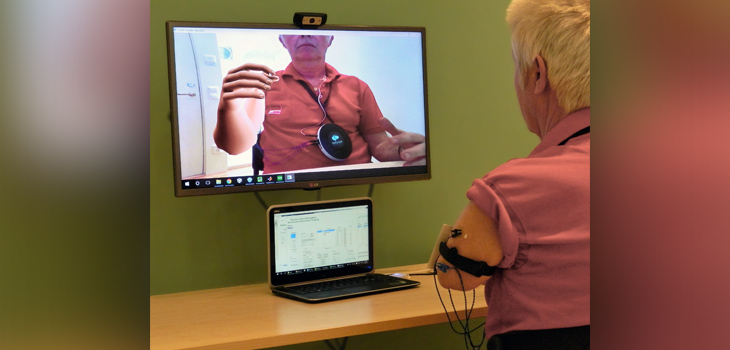
“In the study, researchers placed sensors on the patients’ stumps to detect muscular activity for the missing arm. The signals were then fed into a computer that decoded and used them to create an active virtual arm on a computer screen, representing the missing limb. There were three parts to the therapy (see video at https://youtu.be/ek7JHGC-T4E), which involved patients training the virtual limb, driving a virtual race car around a track using their phantom movements and copying the movements of an on-screen limb with their phantom movements in 12 two-hour treatment sessions.”
“The study found that on average the intensity, quality and frequency of phantom limb pain halved following treatment—with a 32% reduction in the intensity of the pain, a 51% reduction in pain quality and intensity and a 47% reduction in its duration, frequency and intensity…The number of patients feeling constant pain reduced from 12 to 6 patients at six month follow-up, and ‘stabbing’ and ‘tiring/exhausting’ pains in the phantom limb were statistically less common after the treatment.”
Dr. Ortiz Catalan told OTW, “During my research on osseointegration and neural control of prosthesis I met several patients who suffered from PLP [phantom limb pain], and were not candidates for our implantable system, so I designed this other alternative that is non-invasive. This system can be used early after surgery to treat PLP and improve motor control.”
“It was interesting to find that PLP could be reduced after few sessions even after decades of suffering pain. We are now starting a clinical trial in six countries.”
React:
Discussion
This is a fascinating development. In my practice we've seen similar outcomes with the revised protocol. The key differentiator seems to be patient selection criteria. Has anyone else noticed the correlation with BMI thresholds?
Great point. I'd push back slightly on the conclusion, the sample size in the cited study is too small to draw population-level inferences. That said, the directional signal is compelling and worth a larger RCT.
We implemented a similar approach last year. Early results are promising but we're still gathering 12-month follow-up data. Happy to share our protocol if anyone is interested.
Join the conversation
Orthopedic professionals are discussing this. Sign in and upgrade to read every comment and add your voice.