
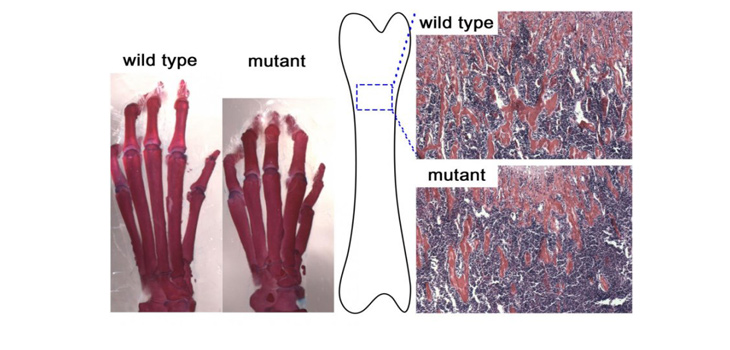
By knocking out the Speckle-type POZ Protein (Spop) in a mouse, researchers from Penn State University have discovered that this protein is critical for skeletal development. The resulting condition, known as brachydactyly, leads to a shortening of the fingers and toes.
Skeletal Defects Caused by Protein Loss
2 min read Premium comments
Secondary
“The Spop protein is involved in Hedgehog signaling—a well-studied cell-to-cell communication pathway that plays multiple roles during development, ” said Aimin Liu, Ph.D., associate professor of biology at Penn State and the corresponding author of the study, in the December 6, 2016 news release. “Previous studies done in cell culture suggested that Spop negatively regulates or ‘turns down’ Hedgehog signaling. However, in our study, we show that Spop positively regulates the pathway downstream of a member of the Hedgehog family, a protein called Indian Hedgehog, during bone development. This new understanding adds to our knowledge of the genetic basis of bone development and could open new avenues to study bone disease.”
“…Limbs that lacked Spop had less dense bone, mimicking osteopenia—a human condition characterized by low bone density, but not as severe as osteoporosis. The limbs also had shorter than normal fingers and toes. The researchers also showed that the effects of losing Spop could be mitigated by simultaneously reducing the amount of Gli3 in the limbs.”
Dr. Liu told OTW, “My lab is interested in the roles of Hedgehog signaling in mediating cell/cell communication in mammalian development and Spop was suspected to be an important regulator of this signaling pathway. Therefore, we acquired the mutant mice and discovered that Spop regulates bone development through its function in Ihh signaling.”
“The lesson I learned from our result and many other similar ones is that in addition to nutritional and environmental factors that were known to be important for osteoporosis pathogenesis, genetics also plays important roles. I believe that better understanding of the genetic basis of the bone density loss helps a doctor to better explains the condition to patients and may guide prevention efforts as well.”
“What I found most interesting was how important context is for the function of genes. Spop has earned its fame as a tumor suppressor gene that is frequently mutated in various types of cancers. And yet, we show that it is essential for cellular differentiation, but not proliferation in the context of bone and cartilage.”
“We are investigating the other developmental defects in Spop mutants, including the CNS [central nervous system] and cardiovascular defects. I am also in contact with some people discussing the possibility of collaborating on investigating tumorigenesis in Spop mutants. In the long run, I hope to collaborate with clinicians to figure out whether mutations in Spop or other factors in Hh signaling are associated with increased incidence or severity in skeletal diseases like osteoporosis and brachydactyly.”
Author
React:
Discussion
This is a fascinating development. In my practice we've seen similar outcomes with the revised protocol. The key differentiator seems to be patient selection criteria. Has anyone else noticed the correlation with BMI thresholds?
Great point. I'd push back slightly on the conclusion, the sample size in the cited study is too small to draw population-level inferences. That said, the directional signal is compelling and worth a larger RCT.
We implemented a similar approach last year. Early results are promising but we're still gathering 12-month follow-up data. Happy to share our protocol if anyone is interested.
Join the conversation
Orthopedic professionals are discussing this. Sign in and upgrade to read every comment and add your voice.