
Paradigm Spine, LLC is pleased to highlight the recent publication of the International Society for the Advancement of Spine Surgery (ISASS) Policy Statement by Richard Guyer, M.D. and colleagues. The paper, “ISASS Recommendations/Coverage Criteria for Decompression with Interlaminar Stabilization – Coverage Indications, Limitations, and/or Medical Necessity” appears in the International Journal of Spine Surgery (volume 10, article 41).
Paradigm Spine: ISASS Guidelines on Interlaminar Stabilization
2 min read Premium comments
Secondary
As indicated in the December 6, 2016 news release, “Per the Policy Statement, lumbar decompression with interlaminar stabilization is recommended for coverage in carefully selected LSS [lumbar spinal stenosis] patients without gross instability or in which the decompression procedure itself may create iatrogenic instability. The Policy Statement accurately notes that ‘there exists a population of patients who present with moderate to severe stenosis, with concomitant back pain, where decompression alone does not adequately address back pain.’ Interlaminar stabilization after direct decompression is a non-fusion surgical option that can provide the additional stability over decompression alone without the rigidity of an instrumented fusion. The Policy recognizes the benefits of coflex® compared to fusion and further states, ‘In select patients within the LSS continuum, decompression with interlaminar stabilization has proven to provide equivalent outcomes with a reduced cost compared to decompression plus fusion.’”
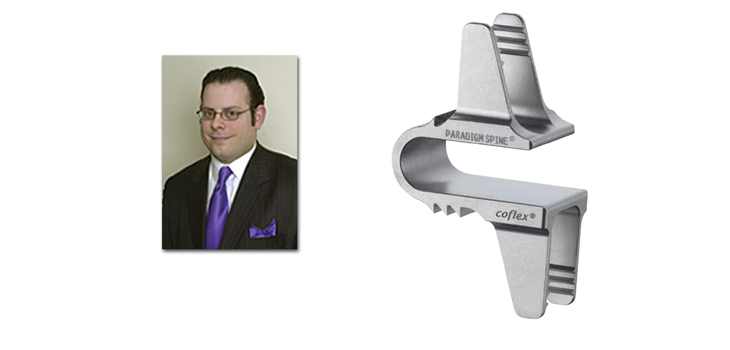
“As the only spine product that has achieved FDA Premarket Approval (PMA) for up to a Grade I spondylolisthesis with a concomitant decompression, the coflex Interlaminar Stabilization non-fusion device maintains motion, reduces both leg and back pain, and preserves foraminal height.”
Company Executive Vice President and Chief Medical Officer Hallett Mathews, M.D., M.B.A., of commented, “We are very happy that ISASS has issued these important guidelines and are confident that it will be immensely helpful to all physicians and patients. Surgeons, health insurers and policy makers rely on publications issued by societies for current information on leading industry developments, clinical advancements and for guidance in making choices on various treatment methods for their patients. As the publication appropriately states, with the growing population in the U.S., there is a rising incidence of LSS and varying options of therapeutic pathways. Therefore, it is becoming increasingly important for the new treatment alternatives available for LSS to be supported by strong clinical data from long-term studies, as coflex has recently published its own five-year study results. Over the last four years, more than 1, 000 physicians in the U.S. have treated nearly 20, 000 patients and now with these published guidelines by ISASS and having its own new CPT [Current Procedural Terminology] code becoming effective January 1, 2017, using coflex for interlaminar stabilization after a decompression is quickly becoming the preferred choice of treatment by many physicians in both an in-patient and out-patient setting.
Chairman and CEO Marc Viscogliosi told OTW, “We are pleased ISASS issued coverage guidelines supporting the utilization of decompression with coflex interlaminar stabilization. With the 2017 coding changes, including site of service inpatient and outpatient facility payments, we are excited about the opportunity for surgeons to offer coflex as an evidence-based, society-supported solution for their lumbar stenosis patients.”
Author
React:
Discussion
This is a fascinating development. In my practice we've seen similar outcomes with the revised protocol. The key differentiator seems to be patient selection criteria. Has anyone else noticed the correlation with BMI thresholds?
Great point. I'd push back slightly on the conclusion, the sample size in the cited study is too small to draw population-level inferences. That said, the directional signal is compelling and worth a larger RCT.
We implemented a similar approach last year. Early results are promising but we're still gathering 12-month follow-up data. Happy to share our protocol if anyone is interested.
Join the conversation
Orthopedic professionals are discussing this. Sign in and upgrade to read every comment and add your voice.