
Break out the power tools, ladies…there is plenty of room for you in the orthopedic field! Despite this, according to the Academy of Orthopaedic Surgeons (AAOS), only 7% of today’s practicing orthopedists are women. However, a nonprofit known as The Perry Initiative is doing its utmost to make careers in orthopedic surgery and engineering possible for high school and college-aged women. When The Perry Initiative brought its hands-on training program to Atlanta, Georgia recently, OrthoAtlanta was on site to lend a hand.
OrthoAtlanta, Perry Initiative Hold Training for Women in Orthopedics
2 min read Premium comments
Secondary
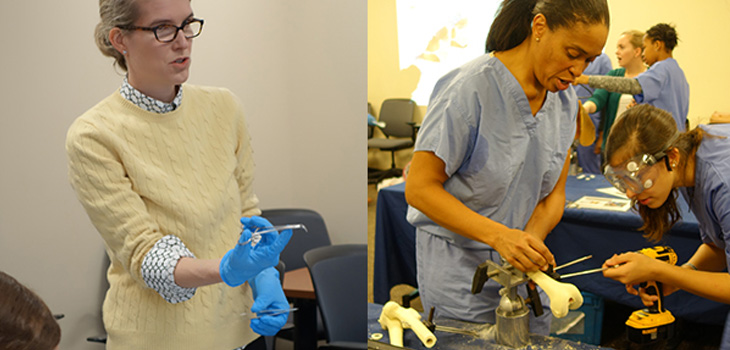
OrthoAtlanta orthopedic surgeons Susan S. Jordan, M.D., specializing in sports medicine, and Sharrona S. Williams, M.D., specializing in foot and ankle surgery, joined several other professionals in providing insights, tips, hands-on training and encouragement to more than 30 high school students from across the state of Georgia.
As stated in the November 22, 2016 news release, “Named for Dr. Jacquelin Perry, one of the first female orthopedic surgeons in the United States, The Perry Initiative was founded in 2009 by Dr. Jenni Buckley, a mechanical engineer, and Dr. Lisa Lattanza, an orthopedic surgeon. The nonprofit runs some 40 day-long outreach programs nationwide, aimed at inspiring young women to be leaders in engineering and the specialized medical field of orthopedic surgery. The Perry Initiative provides young women with needed exposure to a range of career options, access to women excelling in these fields, and confidence to apply their own diverse interests and unique life experiences into successful careers as orthopedic surgeons or engineers.”
During the hands-on training, Dr. Susan Jordan guided students in the basics of suturing wounds. Dr. Sharrona Williams guided students in urgent fracture care, including the use of power tools, addressing broken bones, and stabilizing injuries until they can be set.
Asked about some of the obstacles to these young women entering the field, Dr. Jordan told OTW, “The first obstacle for women is realizing that they can succeed in the field of orthopedics. Many female students haven’t been exposed to women in orthopedics and that is unfortunate. Another obstacle for women and men alike is that competition to enter the field is very stiff. Grades, board scores, and recommendations must all be top notch.”
“Once in the field, the challenges are the same as any high intensity job. Thankfully, women can overcome these challenges just as well as men and enjoy the enormous job satisfaction of being an orthopedic surgeon.”
As for questions they received from the potential candidates, Dr. Williams noted, “The energy and excitement of the girls was palpable. The recurrent question was focused on the educational path and what these ladies should do to be more competitive. They were also very interested in the type of surgical cases that we encounter.”
Dr. Jordan added, “The students brought great enthusiasm and curiosity to the course. Many had questions about the training and path to becoming a sports medicine orthopod. Some were interested specifically in on-field experiences with athletes.”
Author
React:
Discussion
This is a fascinating development. In my practice we've seen similar outcomes with the revised protocol. The key differentiator seems to be patient selection criteria. Has anyone else noticed the correlation with BMI thresholds?
Great point. I'd push back slightly on the conclusion, the sample size in the cited study is too small to draw population-level inferences. That said, the directional signal is compelling and worth a larger RCT.
We implemented a similar approach last year. Early results are promising but we're still gathering 12-month follow-up data. Happy to share our protocol if anyone is interested.
Join the conversation
Orthopedic professionals are discussing this. Sign in and upgrade to read every comment and add your voice.