
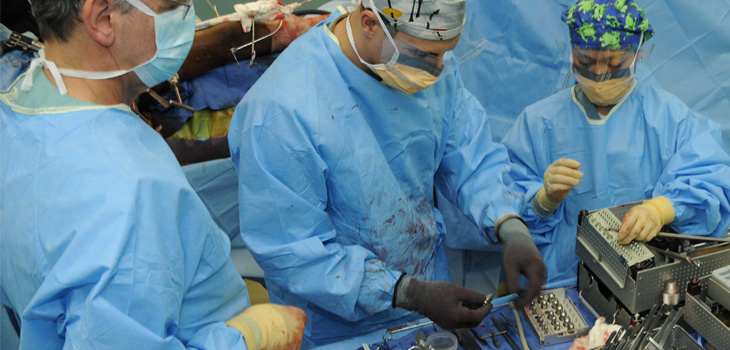
When surgeons, hospitals, patients, and device manufacturers pull together, miracles are possible. From December 5-10, 2016, approximately 80 patients received joint replacements free of charge from 40 orthopedic surgeons who volunteered their time at 35 hospitals. This is thanks to the wonderful annual event organized by Operation Walk USA.
Operation Walk USA: 80 Patients Receive Complimentary Surgery
2 min read Premium comments
Secondary
DePuy Synthes, DJO Global, Inc., Smith & Nephew, plc, Stryker Corporation, Total Joint Orthopedics, Inc., and Zimmer Biomet Holdings, Inc. donated hip and knee implants; SunMedica, Inc., donated orthoRAP and koolRAP products; Force Therapeutics, LLC provided complimentary online care management tools; and Ortech Data, Inc. donated technology for electronic medical record management. Ortech will transfer Operation Walk USA 2015 Health Insurance Portability and Accountability Act compliant data to the American Joint Replacement Registry.
New Albany, Ohio orthopedic surgeon Adolph V. Lombardi, Jr., M.D., president and co-founder of Operation Walk USA, told OTW, “Annually, Operation Walk USA is a national event that takes place during the first week of December. What makes it special to everyone involved—orthopaedic surgeons, other healthcare providers, hospitals, and of course patients and their families—is the realization that in other parts of this country others are doing the same thing: restoring mobility for hard-working, well-deserving fellow Americans who wish for nothing more than to be able to get back to active and productive lives. This is the week when all of us who participate feel united in this mission to help our neighbors in a very meaningful way.”
“Our patients’ stories are always the most fascinating aspect of Operation Walk USA. Behind every name and every face, there is a story of life, hopes and struggles, family and love. They come to us from all walks of life: we have treated retired military, soccer coaches, paralegals, truck drivers, yoga instructors, pastors, animal care givers, singers, dancers, identical twins… Every story is very unique and compelling. Some continue to stay in touch with the organization via social media, and it is immensely gratifying to learn how their lives turn around following their surgeries, in a very positive way.”
Asked about the most heartwarming moment of the event, Dr. Lombardi commented, “Seeing a patient take his or her first steps post-op, seeing their joy and relief, and also—hope. In most cases, these patients have been living in excruciating pain from which there was no relief. It is debilitating, and it can bring down even the most resilient person. Living with constant pain of end-stage arthritis damages the human spirit. Tomorrow, the future—it all seems bleak and quite hopeless. When we bring in these patients for a joint replacement surgery, we replace much more than just an arthritic joint, we restore much more than their limited mobility; we also heal their spirit and give them hope that tomorrow, and the day after, and the day after that they will get better and better. They will be back to doing all those things that they need to do, or enjoy doing from getting a job to being able to play with their kids or grandkids. These are simple everyday things, but take them away—and life loses its meaning. We return our patients back to active lives, to workforce, to their social surroundings and to things they enjoy doing.”
React:
Discussion
This is a fascinating development. In my practice we've seen similar outcomes with the revised protocol. The key differentiator seems to be patient selection criteria. Has anyone else noticed the correlation with BMI thresholds?
Great point. I'd push back slightly on the conclusion, the sample size in the cited study is too small to draw population-level inferences. That said, the directional signal is compelling and worth a larger RCT.
We implemented a similar approach last year. Early results are promising but we're still gathering 12-month follow-up data. Happy to share our protocol if anyone is interested.
Join the conversation
Orthopedic professionals are discussing this. Sign in and upgrade to read every comment and add your voice.