
North Shore University Hospital in Manhasset, New York, is the first center in the Eastern United States—and the second nationally—to perform combined kyphoplasty intraoperative radiation therapy (IORT) for spinal metastasis.
North Shore: Second Doing Spinal Kyphoplasty IORT
2 min read Premium comments
Secondary
According to the November 14, 2016 news release, Andre Hayden, 47, of Wheatley Heights, New York, received the treatment due to Stage 4 colon cancer that metastasized to his spine, causing debilitating pain even after completing a course of spine external irradiation. The minimally invasive joint procedure was performed on November 3 by neurosurgeon Ahmad Latefi, D.O. and radiation oncologist Maged Ghaly, M.D.
“For cancer patients with spinal metastasis, it is often recommended that after surgery to stabilize the spine, most of these patients will be offered short-course of conventional external beam radiation therapy (cEBRT), which has been associated with short-term pain control and low rates of complete response to pain, ” said Dr. Ghaly. “Furthermore, approximately 20 percent [%] of patients will suffer pain progression following cEBRT, requiring treatment.”
In Hayden’s case, says the news release, he suffered from a painful, pathologic vertebral fracture caused by the tumor. A second course of external irradiation would result in spine fracture progression.
“Kypho-IORT is a novel approach to combine kyphoplasty, a minimally invasive procedure with a single dose of intraoperative radiation therapy for the treatment of unstable or potentially unstable spinal cord metastases, even if patients had prior spine radiation, ” said Dr. Latefi. “This integrated palliative treatment option improves the patient’s quality of life with quicker pain relief and without interrupting their systemic therapy.”
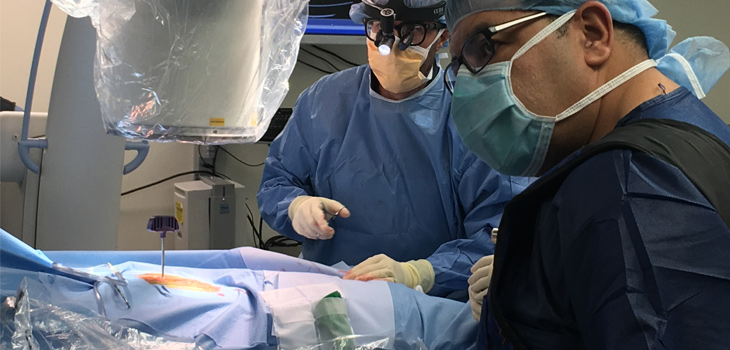
“During the first part of the procedure, Dr. Latefi made a small incision in the spine and then inserted an Intrabeam needle applicator, manufactured by Carl Zeiss Meditec. Dr. Ghaly performed the IORT procedure by delivering radiation treatment directly into the tumor, preserving the spinal cord and surrounding tissue. During the next stage kyphoplasty, Dr. Latefi placed a catheter through the small incision. A balloon placed at the tip of the catheter was inflated to restore the height of the vertebrae. A cement-like substance was injected into the spine, fortifying the vertebrae against future collapse.”
Hayden was able to be discharged the same day as the procedure, and was able to resume his daily activities.
Dr. Ghaly told OTW, “For many cancer patients who develop spinal metastases in the course of their disease, percutaneous cement augmentation is a valuable treatment option as proven recently in a randomized trial. By using intraoperative radiotherapy with the Zeiss Intrabeam System during cement augmentation, the metastasis can be sterilized and simultaneously the vertebra can be stabilized, a process resulting in fast reduction of the patient’s pain. It also enables instant full weight bearing and restores mobility, enhancing the patient’s quality of life.”
“The first clinical trial experiences of this approach have yielded very promising results with an intraoperative risk profile comparable to cement augmentation alone yielding increased patient convenience by reducing both the treatment time and hospitalization time when compared to conventional multifraction radiation treatment. It is interesting that it is possible to optimize patients’ life quality without interfering with their convenience.”
React:
Discussion
This is a fascinating development. In my practice we've seen similar outcomes with the revised protocol. The key differentiator seems to be patient selection criteria. Has anyone else noticed the correlation with BMI thresholds?
Great point. I'd push back slightly on the conclusion, the sample size in the cited study is too small to draw population-level inferences. That said, the directional signal is compelling and worth a larger RCT.
We implemented a similar approach last year. Early results are promising but we're still gathering 12-month follow-up data. Happy to share our protocol if anyone is interested.
Join the conversation
Orthopedic professionals are discussing this. Sign in and upgrade to read every comment and add your voice.