
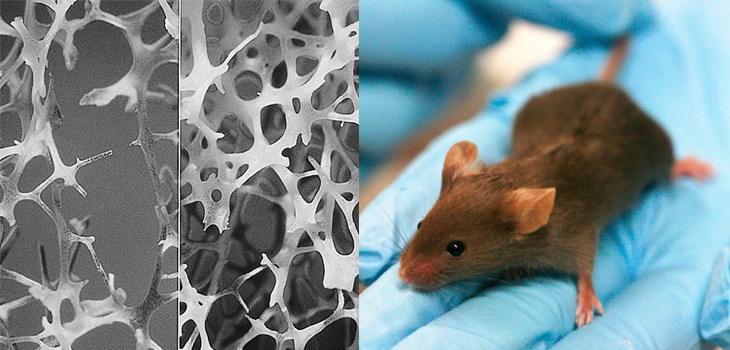
Researchers from the Children’s Medical Center Research Institute at The University of Texas Southwestern (CRI) have discovered a new bone-forming growth factor, Osteolectin (Clec11a), which reverses osteoporosis in mice.
New Growth Factor Reverses Osteoporosis in Mice
2 min read Premium comments
Secondary
As indicated in the December 13, 2016 news release, “Although Osteolectin is known to be made by certain bone marrow and bone cells, CRI researchers are the first to show Osteolectin promotes the formation of new bone from skeletal stem cells in the bone marrow. The study, published on December 13, 2016 in eLife, also found that deletion of Osteolectin in mice causes accelerated bone loss during adulthood and symptoms of osteoporosis, such as reduced bone strength and delayed fracture healing.”
“These results demonstrate the important role Osteolectin plays in new bone formation and maintaining adult bone mass. This study opens up the possibility of using this growth factor to treat diseases like osteoporosis, ” said Sean Morrison, Ph.D., who led the team that made the discovery. Dr. Morrison, CRI Director, holds the Mary McDermott Cook Chair in Pediatric Genetics at UT Southwestern Medical Center, and the Kathryne and Gene Bishop Distinguished Chair in Pediatric Research at Children’s Research Institute at UT Southwestern.
Dr. Morrison told OTW, “We have been characterizing the microenvironment in the bone marrow to better understand the mechanisms that regulate the function of blood-forming and bone-forming stem cells in adult bone marrow. We discovered that Osteolectin is produced by the same cells that secrete the factors that promote the maintenance of both kinds of stem cells. To test whether Ostelectin encodes an undiscovered growth factor activity we generated knockout mice. The mice were born in normal numbers, appeared to be developmentally normal, and had normal hematopoiesis but exhibited acclerated bone loss during aging—they developed early onset osteoporosis. This told us that Osteolectin is required for the maintenance of the adult skeleton. We went on to show that Osteolectin maintains the adult skeleton by promoting the differentiation of skeletal stem cells into mature osteoblasts.”
“Osteolectin is a new anabolic, bone-forming growth factor. Administration of Osteolectin to mice with osteoporosis systemically promotes for the formation of new bone. We are currently testing whether osteolectin has the potential to be used as a bone therapeutic in humans.”
React:
Discussion
This is a fascinating development. In my practice we've seen similar outcomes with the revised protocol. The key differentiator seems to be patient selection criteria. Has anyone else noticed the correlation with BMI thresholds?
Great point. I'd push back slightly on the conclusion, the sample size in the cited study is too small to draw population-level inferences. That said, the directional signal is compelling and worth a larger RCT.
We implemented a similar approach last year. Early results are promising but we're still gathering 12-month follow-up data. Happy to share our protocol if anyone is interested.
Join the conversation
Orthopedic professionals are discussing this. Sign in and upgrade to read every comment and add your voice.