
A toothpaste-like substance is making inroads into our ability to control bleeding. As indicated in the November 16, 2016 news release, “…clinicians often use tiny metallic coils, which can be permanently inserted into a blood vessel to prevent further bleeding. But such coils come with limitations. Patients on blood thinning medications or who cannot form blood clots for other reasons can experience dangerous break-through bleeding, with rebleeding occurring in as many as 47 percent of patients.”
New Biomaterial to Prevent Uncontrolled Bleeding
2 min read Premium comments
Secondary
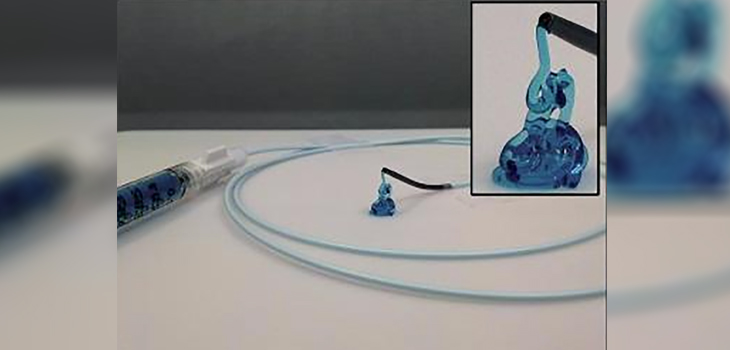
Bioengineers from Brigham and Women’s Hospital, led by Ali Khademhosseini, Ph.D., collaborated with Rahmi Oklu M.D., Ph.D., FSIR, a clinician who is an interventional radiologist (previously at Massachusetts General Hospital, now at Mayo Clinic). Their team developed a rapidly deployable hydrogel that can hold its shape within a blood vessel to prevent bleeding, even in those who cannot form blood clots.
As noted in the news release, “The new agent, known as a shear-thinning biomaterial (STB), has a consistency similar to toothpaste and is made up of both gelatin—which gives it gel like properties—and nanoparticles. Using a catheter, the material can be flowed into a blood vessel but is able to maintain its shape once inside the vessel, obstructing the vessel or aneurysm without relying on the formation of a blood clot. Mechanical testing in the lab was initially performed and monitored the STB’s changes over time to optimize the material’s properties in animal models. The team then tested the STB in both rodent and porcine models, the latter of which have blood vessels of similar dimensions to human blood vessels.”
“Some of the beneficial properties of the STB include its ability to withstand pressure within the blood vessel, remain at the site of injection and naturally degrade over time. In addition, the team found that the material attracted cells to migrate and deposit themselves at the site of the STB, helping to block the vessel. The individual component materials that make up the STB have been previously used in humans making their subsequent regulatory process and clinical use easier.”
Dr. Khademhosseini told OTW, “Similar types of shear thinning materials may have important implications in bone tissue engineering. This material works in applications where current therapies fall short. For example it can work independent of blood clot formation. We aim to push this forward by doing toxicology studies and clinical trials.”
React:
Discussion
This is a fascinating development. In my practice we've seen similar outcomes with the revised protocol. The key differentiator seems to be patient selection criteria. Has anyone else noticed the correlation with BMI thresholds?
Great point. I'd push back slightly on the conclusion, the sample size in the cited study is too small to draw population-level inferences. That said, the directional signal is compelling and worth a larger RCT.
We implemented a similar approach last year. Early results are promising but we're still gathering 12-month follow-up data. Happy to share our protocol if anyone is interested.
Join the conversation
Orthopedic professionals are discussing this. Sign in and upgrade to read every comment and add your voice.