
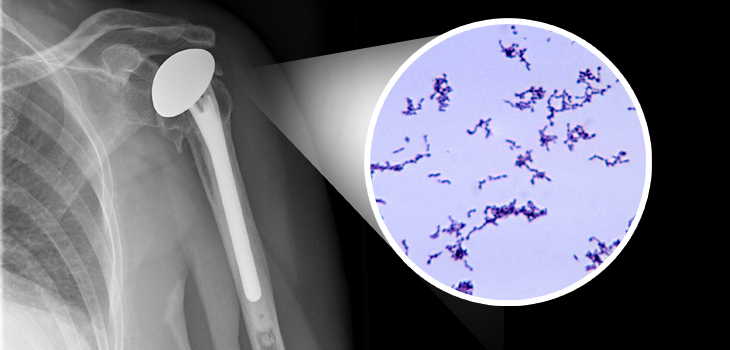
Propionibacterium (P) acnes infection of the shoulder after arthroplasty is a scourge for patients and surgeons alike as it can involve serious complications. Current detection methods for P acnes involve anaerobic cultures that require incubation periods of 7-14 days. Now, research that has won the 2017 Charles S. Neer Award from The American Shoulder and Elbow Surgeons society has resulted in a method to identify P acnes within 24 hours.
Neer Award: Rapidly Detect Propionibacterium acnes in Shoulder
2 min read Premium comments
Secondary
David O’Gorman M.Sc., Ph.D. is co-director of Research at the Cellular and Molecular Research Laboratory, Roth McFarlane Hand and Upper Limb Centre at St. Joseph’s Healthcare in London, Ontario. A co-author on the study, Dr. O’Gorman told OTW, “The main reason this research was undertaken was to address a clinical problem, namely the extended time (typically weeks) required to grow cultures and confirm a Propionibacterium acnes (P acnes) infection of the shoulder after surgery. The publication [“A Rapid Detection Method for Propionibacterium acnes from Surgical Biopsies of the Shoulder”] describes a methodology to detect and confirm the presence of P acnes DNA in a shoulder tissue sample in a much shorter period of time (~24hrs) that does not require any cultures. The sooner a physician can confirm the presence of this organism in the shoulder, the sooner they can make clinical decisions about how to proceed.”
“As for the primers we designed, the technique we use requires small, single stranded pieces of DNA called ‘primers’ to ‘anneal’ (attach) to P acnes DNA. We use these primers (2 different ones) to perform polymerase chain reaction (PCR), a technique where the DNA that lies between the annealing sites of the two primers can be amplified many thousands of times. The region we amplified is within a gene that all bacteria contain, but is quite variable between different bacterial species. This difference between species allows us to specifically amplify only P acnes DNA and not the DNA of other bacteria. We also cut this amplified DNA into fragments using an enzyme (HaeIII, a ‘restriction’ enzyme to be precise) to check that the fragments are exactly the sizes we predict them to be. This is a ‘double check’ to ensure that we amplified DNA from P acnes and not some other microbe by mistake.”
“With regard to plans for the future, we hope to enhance the technology to be able to ‘rank’ the P acnes we detect on a scale of least to most invasive/destructive by assessing their expression of virulence genes. We are also interested in developing a ‘point of care’ (POC) assay that would allow us to confirm the presence of P acnes within the time span of the operation itself. That will be technically challenging, but would also be a very valuable addition to the surgeons ‘toolkit’ to detect and treat P acnes infections of the shoulder in a timely manner.”
Author
React:
Discussion
This is a fascinating development. In my practice we've seen similar outcomes with the revised protocol. The key differentiator seems to be patient selection criteria. Has anyone else noticed the correlation with BMI thresholds?
Great point. I'd push back slightly on the conclusion, the sample size in the cited study is too small to draw population-level inferences. That said, the directional signal is compelling and worth a larger RCT.
We implemented a similar approach last year. Early results are promising but we're still gathering 12-month follow-up data. Happy to share our protocol if anyone is interested.
Join the conversation
Orthopedic professionals are discussing this. Sign in and upgrade to read every comment and add your voice.