
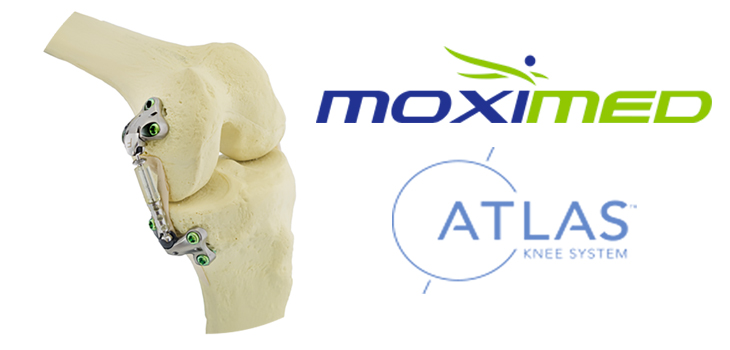
Moximed, Inc. is announcing that the first patient has been treated in an FDA-approved Investigational Device Exemption (IDE) study for its latest generation unicompartmental unloading implant, the Atlas System.
Moximed: First Patient for IDE on Atlas System
2 min read Premium comments
Secondary
“I’m pleased to treat the first patient in the Atlas IDE study. I see in my practice a tremendous number of younger, early OA [osteoarthritis] patients who are seeking an alternative to arthroplasty that will allow them to maintain a highly active lifestyle, ” noted Andreas Gomoll, M.D., Associate Professor of Orthopaedic Surgery at Harvard Medical School and Director of the Orthopaedic Program at the Brigham and Women’s Hospital Center for Regenerative Medicine, in the November 29, 2016 news release. “Load distribution plays an important role in early osteoarthritis, and these patients could potentially benefit from a joint unloading procedure.”
The Principal U.S. Investigator of the previous Moximed clinical study (KineSpring System), Jack Farr, M.D., Director of the OrthoIndy Cartilage Restoration Center of Indiana and the OrthoIndy Sports Medicine Fellowship Program remarked, “The Atlas System provides the same 30 lbs. of joint unloading with a significantly smaller implant and anatomically-guided surgical technique. Patients intuitively understand the concept of a shock absorber and are excited about a procedure that preserves their own anatomy without the bone cuts associated with joint replacement.” He went on to say, “I am looking forward to enrolling my first patients in the Atlas Study.”
Moximed CEO Kevin Sidow commented to OTW, “The Atlas acts as a shock absorber for the knee in symptomatic, early-to-moderate knee OA patients. The patients are typically 35 – 65 years of age, which is the fastest growing segment of a large, symptomatic knee OA patient population. These people want to maintain high activity levels, quality of life, and jobs. The Atlas is meant for a pre-arthroplasty patient who hopes to delay joint replacement.”
“It is common for Moximed patients to return to high impact activities (running, jumping) that are not recommended for patients with joint replacement. The typical surgeon user of the Atlas System has a sports medicine practice, has previously treated many of these patients for meniscus, ligament, or cartilage injury, and is comfortable with outpatient procedures.
“While we cannot divulge much on the pre-CE Mark clinical study data because the 1-year data will be submitted for journal publication, we can say that at one year, over 90% of the patients reported clinically significant pain relief on validated outcomes measures. Nearly 20% of the patients were on medical leave or working from home before the surgery, but were able to return to work. The first patients with the previous version of the Moximed shock absorber (KineSpring) devices are now eight and a half years post-surgery.”
Dr. Gomoll told OTW, “The Atlas is an intriguing device that has the potential to bridge young patients with osteoarthritis to a later age when joint replacement becomes a reasonable option. I see many of these patients that currently don’t have good treatment options: too young and/or active for even partial knee replacement, and who have had inadequate response to non-operative options such as NDAIDs, steroid or HA injections, and unloaded bracing.”
React:
Discussion
This is a fascinating development. In my practice we've seen similar outcomes with the revised protocol. The key differentiator seems to be patient selection criteria. Has anyone else noticed the correlation with BMI thresholds?
Great point. I'd push back slightly on the conclusion, the sample size in the cited study is too small to draw population-level inferences. That said, the directional signal is compelling and worth a larger RCT.
We implemented a similar approach last year. Early results are promising but we're still gathering 12-month follow-up data. Happy to share our protocol if anyone is interested.
Join the conversation
Orthopedic professionals are discussing this. Sign in and upgrade to read every comment and add your voice.