
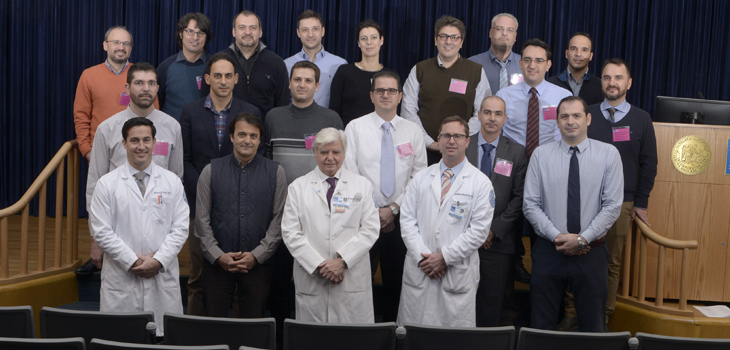
An annual learning event recently took place at Hospital for Special Surgery (HSS) in New York. Elite surgeons hosted their colleagues from Greece for the annual HSS Stavros Niarchos Foundation Orthopaedic Seminar Program where they learned the latest techniques and innovations in complex hip and knee reconstruction.
HSS Hosts Greek Surgeons for Annual Symposium
2 min read Premium comments
Secondary
The two day program, moderated by Michael Cross, M.D., and Michael Alexiades, M.D., consisted of case presentations and hands-on workshops at HSS, followed by three days at the HSS Annual Knee and Hip Course, a CME-accredited professional education course. The event welcomes Greek surgeons who have less than 10 years of experience.
“This program continues to foster awareness and solidify HSS’ reputation around the world that we are dedicated to educating orthopedic surgeons on how to improve treatment and outcomes in joint replacement, ” said Dr. Alexiades, in the November 29, 2016 news release. “Participants of this program have and continue to return to Europe to build upon the work they have learned here.”
As indicated in the news release, “Earlier this year, the Foundation announced a grant of $925, 000 over three years to HSS to support professional development programs for Greece’s orthopedic surgeons. The allocation extends a decade-long collaboration between the Foundation and the Hospital, in which more than 75 surgeons from Greece have participated to advance their medical expertise.”
Dr. Cross told OTW, “The program covered complex knee and hip reconstruction, and included topics such as: management of periprosthetic joint infections and bone loss, revision TKA [total knee arthroplasty] and THA [total hip arthroplasty] techniques, and management of periprosthetic fractures around the hip and knee. These topics were chosen based on feedback from previous Greek surgeons who requested more information on complex revisions, since the volume of those procedures in Greece is sometimes limited. Further, because HSS is a referral center for complex revisions and fractures, we tend to see more volume of complex revision THA and TKAs, allowing us to share some of our techniques with the Greek surgeons. We also integrated a cadaver lab into the program, so that the Greek surgeons can get some ‘hands on’ experience with some of the revision systems used in the United States.”
“Through establishing a relationship with our Greek colleagues, we are facilitating knowledge transfer and promoting international collaborative research. Hopefully, when these orthopedic surgeons return to Greece they will be able to implement the techniques learned at HSS so that they can continue to expand the depth of care they can provide to their patients and share the knowledge with their fellow colleagues. Further, the HSS surgeons involved in the course always learn from the Greek surgeons, allowing us to learn different methods of approaching complex problems.”
Filon Agathangelidis, M.D., a seminar participant from Greece, commented to OTW, “Learning from leading surgeons about these options […used to do implants at HSS] was an enlightening experience. I have already contacted the local distributors of these implants regarding their availability [here in Greece].”
Author
React:
Discussion
This is a fascinating development. In my practice we've seen similar outcomes with the revised protocol. The key differentiator seems to be patient selection criteria. Has anyone else noticed the correlation with BMI thresholds?
Great point. I'd push back slightly on the conclusion, the sample size in the cited study is too small to draw population-level inferences. That said, the directional signal is compelling and worth a larger RCT.
We implemented a similar approach last year. Early results are promising but we're still gathering 12-month follow-up data. Happy to share our protocol if anyone is interested.
Join the conversation
Orthopedic professionals are discussing this. Sign in and upgrade to read every comment and add your voice.