
The scientists and regulators at the FDA want those who look to the agency to protect and promote public health to know that there is a “science” to their decision-making progress.
FDA’s Top 10 Regulatory Science Priorities for 2017
2 min read Premium comments
Secondary
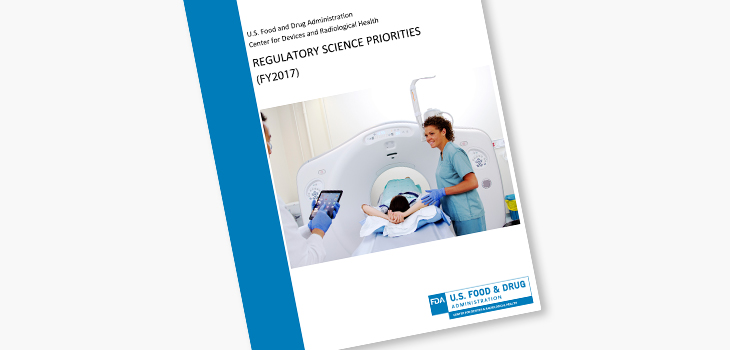
To that end, the agency’s medical device regulators issue a yearly ‘Regulatory Science’ top ten list of priorities. For the New Year, it’s all about “Big Data, ” biological risks, real-world evidence, reducing infections and better predictions for device performance.
Here is the complete list:
- Leverage “Big Data” for regulatory decision-making, including warehouses that host genomics, anatomical, biological, clinical trial and device performance and safety data contain scientific and clinical information relevant to medical devices.
- Modernize biocompatibility and biological risk evaluation of device materials to better determine the safety profile of implantable or patient-contacting medical devices.
- Leverage real-world evidence and employ evidence synthesis across multiple domains in regulatory decision-making as currently most regulatory decisions are based on information provided by manufacturers while data from traditional clinical trials is mostly limited to higher risk devices.
- Advance tests and methods for predicting and monitoring medical device clinical performance.
- Develop methods and tools to improve and streamline clinical trial design.
- Develop computational modeling technologies to support regulatory decision-making. For example, FDA says, “improved multi-modality imaging simulation (e.g., x-ray, CT, MRI, US, optical) and realistic, anthropomorphic digital reference material (i.e., phantoms), could enable robust predictions of imaging system performance for a wider range of patient populations.”
- Enhance the performance of digital health and medical device cybersecurity.
- Reduce healthcare associated infections by better understanding the effectiveness of antimicrobials, sterilization and reprocessing of medical devices.
- Collect and use patient input in regulatory decision-making.
- Leverage precision medicine and biomarkers for predicting medical device performance, disease diagnosis and progression.
Regulatory Science
Just what exactly is “Regulatory Science”?
DRH defines regulatory science as “science in the service of regulation. It helps ensure that regulatory decisions are well-founded and achieve the desired impact on public health, by developing and applying tools, standards and methodologies to study the safety, effectiveness, quality and performance of medical devices and radiation-emitting products under the total product life cycle framework.”
The folks at the FDA’s Center for Devices and Radiological Health (CDRH) say that the difference in this year’s list from the last one is that the agency was able to identify new topic areas (i.e., clinical trial design and precision medicine) as well as describe existing topic areas in greater detail.
“Although the area of human factors is not prominently identified as a priority, it is still an unmet need and is reflected in the descriptions of other 2017 top ten priorities (e.g., infection control and predicting medical device clinical performance).”
These priorities will be used to serve as a guide for making strategic intramural research funding decisions to ensure that CDRH research is focused on needs that are relevant and critical to medical devices and radiation-emitting products.
To read a detailed description of each priority, click here.
Author
React:
Discussion
This is a fascinating development. In my practice we've seen similar outcomes with the revised protocol. The key differentiator seems to be patient selection criteria. Has anyone else noticed the correlation with BMI thresholds?
Great point. I'd push back slightly on the conclusion, the sample size in the cited study is too small to draw population-level inferences. That said, the directional signal is compelling and worth a larger RCT.
We implemented a similar approach last year. Early results are promising but we're still gathering 12-month follow-up data. Happy to share our protocol if anyone is interested.
Join the conversation
Orthopedic professionals are discussing this. Sign in and upgrade to read every comment and add your voice.