
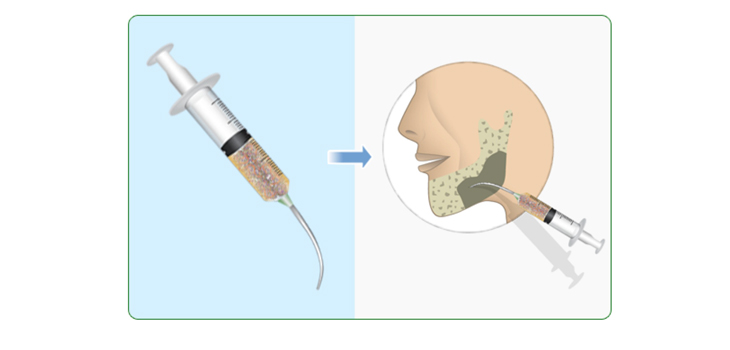
An Israeli biotech company, Bonus Biogroup, has created a semi-liquid graft that, when injected into bone to repair bone loss, hardens and turns into bone. As part of an early stage clinical trial, the company successful injected the product into the jaws of 11 patients to repair bone loss.
Bone Graft Slurry Hardens into Bone in Israeli Trial
1 min read Premium comments
Secondary
The injected material was grown from each patient’s fat cells. It was injected into the voids of damaged bone. Over a period of a few months the material hardened and merged with the existing bone to complete the jaw. The company announced its success in a statement to the Tel Aviv Stock Exchange and will soon present the results of the trial to the International Conference on Oral and Maxillofacial Surgery in Spain.
“For the first time worldwide, reconstruction of deficient or damaged bone tissue is achievable by growing viable human bone graft in a laboratory, and transplanting it back to the patient in a minimally invasive surgery via injection, ” said Chief Executive Shai Meretzki.
Ora Burger, vice president of regulation affairs at Bonus Biogroup, told Reuters the transplant “was 100 percent successful in all 11 patients. Now we are going to conduct a clinical study in the extremities, long bones.”
This may be a second home run for CEO Meretzki. He previously founded Pluristem Therapeutics, Inc. which works with stem cells and is one of the more advanced Israeli biomed companies. Bonus Biogroup, which has raised $14 million, said it plans to dual list on NASDAQ in the coming months.
Author
React:
Discussion
This is a fascinating development. In my practice we've seen similar outcomes with the revised protocol. The key differentiator seems to be patient selection criteria. Has anyone else noticed the correlation with BMI thresholds?
Great point. I'd push back slightly on the conclusion, the sample size in the cited study is too small to draw population-level inferences. That said, the directional signal is compelling and worth a larger RCT.
We implemented a similar approach last year. Early results are promising but we're still gathering 12-month follow-up data. Happy to share our protocol if anyone is interested.
Join the conversation
Orthopedic professionals are discussing this. Sign in and upgrade to read every comment and add your voice.