
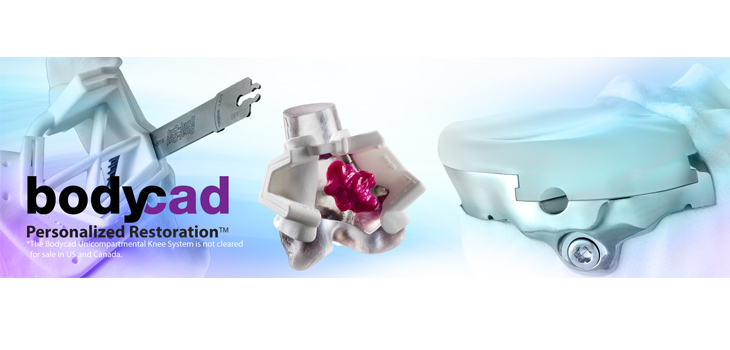
Bodycad, headquartered in Quebec City, Canada, is celebrating two U.S. patents for, according to the December 8, 2016 news release, “improving the accuracy, reproducibility and speed for 3D constructs via magnetic resonance imaging (MRI) and CT images in long and small bone orthopaedic applications…To create personalized orthopaedic restorations, the company harnesses the world’s first suite of orthopaedic CAD/CAM software. This technology, along with individual patient imagery, is critical to Bodycad’s Personalized Restoration Evaluation Process (PREP).”
Bodycad: Two New Patents for 3D Technology
1 min read Premium comments
Secondary
“We are pleased to have the United States Patent and Trademark Office award these important and innovative patents to our library of intellectual property, ” stated company Founder and President Jean Robichaud. “These patents are further evidence of our technology’s remarkable accuracy which is essential when creating a personalized orthopaedic restoration.”
Andrew MacLeod, Chief Commerical Officer, told OTW, “Bodycad is taking a completely different approach to personalizing orthopaedic care by overcoming the limitations of off-the-shelf implants. These most recent patents continue to validate the high degree of accuracy, reproducibility and efficiency with which the company can produce personalized restorations with the goal of meeting a patient’s exact anatomical needs. This approach can be liberating to practitioners who will be able to apply a remarkable level of specificity to their restorations.”
“Bodycad’s intellectual property is robust and these latest patents continue to reinforce the unique value proposition that the company will offer practitioners and patients. By enabling personalized restorations, the company will provide practitioners an alternative to adapting standardized implants for individualized anatomical needs.”
“Bodycad’s proprietary personalized restorations hold tremendous potential with applications ranging from arthroplasty, to oncology, to bone correction (such as osteotomy). The company aims to initially enter markets throughout North America, Europe and Australia.”
React:
Discussion
This is a fascinating development. In my practice we've seen similar outcomes with the revised protocol. The key differentiator seems to be patient selection criteria. Has anyone else noticed the correlation with BMI thresholds?
Great point. I'd push back slightly on the conclusion, the sample size in the cited study is too small to draw population-level inferences. That said, the directional signal is compelling and worth a larger RCT.
We implemented a similar approach last year. Early results are promising but we're still gathering 12-month follow-up data. Happy to share our protocol if anyone is interested.
Join the conversation
Orthopedic professionals are discussing this. Sign in and upgrade to read every comment and add your voice.