
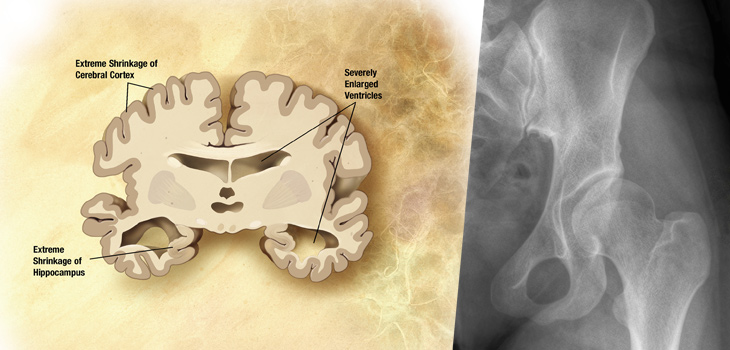
Finnish researchers have discovered that benzodiazepines and related drugs increase the risk of hip fracture by a whopping 43% in Alzheimer’s patients. The study, undertaken at the University of Eastern Finland, was based on the MEDALZ (MEDication use and ALZheimer’s disease) cohort, and included all Finnish people diagnosed with Alzheimer’s between 2005 and 2011 (70, 718 people).
Benzodiazepines: 43% Hip Fracture Increase in Alzheimer’s Patients
1 min read Premium comments
Secondary
According to the November 23, 2016 news release, “In total, 21% of persons with Alzheimer’s disease initiated benzodiazepine and related drug use during the study. During benzodiazepine and related drug use, 2.5 hip fractures occurred per 100 person-years whereas without drug use, the incidence was 1.4 hip fractures per 100 person-years. The use of benzodiazepines and related drugs increased the hip fracture risk especially during the first six months of drug use. There was no difference within the drug group, as benzodiazepines increased the hip fracture risk as much as benzodiazepine-related drugs.”
Laura Saarelainen M.Sc., a Ph.D. student at the School of Pharmacy at the University of Eastern Finland, told OTW, “It is important to consider safer options for benzodiazepine use in older persons, especially in persons with cognitive disorders. However, decreasing drug dose should be performed gradually, especially after long-term use of benzodiazepines, to minimize withdrawal symptoms. Further, it is important to remember that use of benzodiazepines may complicate post-fracture rehabilitation because these drugs may, for example, cause sedation and impair muscular strength.”
“It was interesting to find out that although persons with Alzheimer’s disease experience more hip fractures compared with other older persons, benzodiazepine use still increased the hip fracture risk by more than 40%. Also the association between benzodiazepine use and longer post-fracture hospital stay was surprising.”
“I am proceeding with my research on adverse events of benzodiazepine use in persons with Alzheimer’s disease. Further, the MEDALZ research group is investigating other drugs acting on central nervous system and the risk of fractures, especially hip fractures.”
React:
Discussion
This is a fascinating development. In my practice we've seen similar outcomes with the revised protocol. The key differentiator seems to be patient selection criteria. Has anyone else noticed the correlation with BMI thresholds?
Great point. I'd push back slightly on the conclusion, the sample size in the cited study is too small to draw population-level inferences. That said, the directional signal is compelling and worth a larger RCT.
We implemented a similar approach last year. Early results are promising but we're still gathering 12-month follow-up data. Happy to share our protocol if anyone is interested.
Join the conversation
Orthopedic professionals are discussing this. Sign in and upgrade to read every comment and add your voice.