
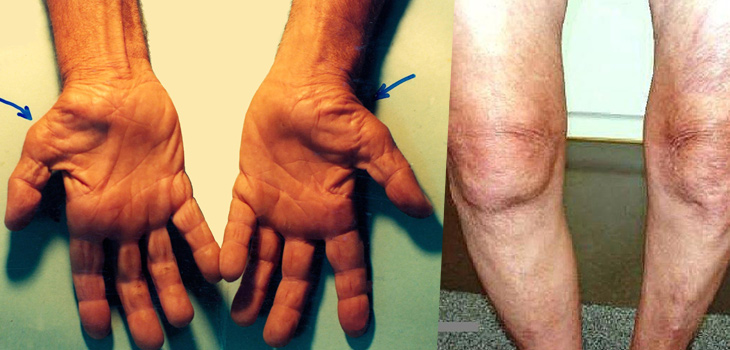
Clarity is good! The American Academy of Orthopaedic Surgeons (AAOS) Board of Directors has just approved new Appropriate Use Criteria (AUC) for the management of carpal tunnel syndrome (CTS) and the surgical management of osteoarthritis of the knee. The AUCs are built on existing related clinical practice guidelines (CPGs) “Management of Carpal Tunnel Syndrome” and “Surgical Management of Osteoarthritis of the Knee.” The CPGs and AUCs are available at www.orthoguidelines.org.
AAOS: New Treatment Criteria for CTS and Knee OA
2 min read Premium comments
Secondary
The AUC for carpal tunnel syndrome provides 135 diagnostic scenarios, as well as optimal treatments.
“Carpal tunnel is a complex diagnosis, ” said Robert H. Quinn, M.D., AUC Section Leader on the Committee on Evidence-Based Quality and Value, in the December 12, 2016 news release. “With a very common condition like carpal tunnel syndrome, which has seen a significant variation in the approach, diagnosis and treatment, the AUC succinctly directs the provider toward a fairly narrow and evidence-based decision making and treatment pathway.”
When there is insufficient evidence to support CTS, “the decision making shifts to investigating alternative diagnoses, ” said Dr. Quinn.
As for the “Appropriate Use Criteria for the Surgical Management of Osteoarthritis of the Knee, ” the news release indicates that it “looks at three types of surgical treatment—total knee replacement (TKR), unicompartmental knee replacement (partial replacement of the knee joint), and realignment osteotomy (cutting and reshaping either the tibia/shinbone or femur/thighbone to relieve pressure on the knee joint)—and the scenarios when each is appropriate.”
“The younger you are the longer you will have to live with the treatment, and a higher likelihood that your treatment will have to be revised, ” said Dr. Quinn. “We want to preserve as much of the normal anatomy as possible for as long as possible.”
Asked for details, Dr. Quinn told OTW, “The algorithm from the AUC helps prompt a provider to perform appropriate testing and/or consider alternative diagnoses, particularly for the new patient with low or moderate probability of CTS on clinical examination. The prompts are: (1) investigate further: electrodiagnostic study, or (2) investigate alternative diagnosis. Beyond that, no, there is no direction on specific alternative diagnoses.”
“The biggest challenge in coming up with the scenarios is in trying to insure that all significant patient parameter are included so that we don’t ‘miss’ any one important patient scenario.”
“For CTS, patients with cervical radiculopathy or sites of nerve entrapment other than the carpal tunnel may confuse the diagnosis.”
Author
React:
Discussion
This is a fascinating development. In my practice we've seen similar outcomes with the revised protocol. The key differentiator seems to be patient selection criteria. Has anyone else noticed the correlation with BMI thresholds?
Great point. I'd push back slightly on the conclusion, the sample size in the cited study is too small to draw population-level inferences. That said, the directional signal is compelling and worth a larger RCT.
We implemented a similar approach last year. Early results are promising but we're still gathering 12-month follow-up data. Happy to share our protocol if anyone is interested.
Join the conversation
Orthopedic professionals are discussing this. Sign in and upgrade to read every comment and add your voice.