
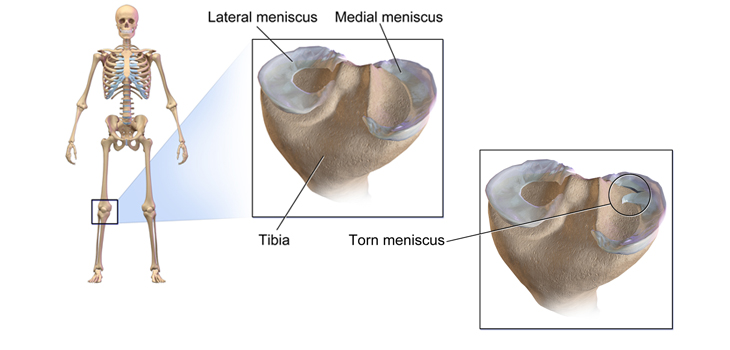
A team of researchers from Baylor College of Medicine has just published a paper in RadioGraphics indicating the importance of recognizing and treating tears of the root of the meniscus. In their paper, they offer communication tools that can help radiologists and surgeons obtain clarity.
Recognize, Treat Meniscal Root Tears!
1 min read Premium comments
Secondary
“Tears at the root of the lateral or medial meniscus can be a cause of knee pain, and while a root tear might be suspected during an exam, an MRI scan is the best diagnostic modality of picking up these injuries, ” said Theodore Shybut, M.D., assistant professor of orthopedic surgery at Baylor and a co-author of the paper, in the November 14, 2016 news release.
“The biomechanics research suggests that if you can repair the root and get it to heal, you may help postpone osteoarthritis of the knee on the medial side. On the lateral side, you are usually addressing instability, ” said Shybut. “Raising awareness of these injuries is important so radiologists and surgeons are looking for them, ” said Shybut.
Dr. Shybut told OTW, “Meniscal root tears are more common than many orthopedic surgeons and musculoskeletal radiologists realize. Medial tears are frequently seen in middle-aged people and can be degenerative. Lateral root tears are often seen in the setting of anterior cruciate ligament (ACL) injury. The biomechanical consequences of root tear are significant for knee instability and increased peak loading of articular cartilage in the involved knee compartment. Treatment of medial root tears with a degenerative component remains challenging.”
“Reviewing images from Dr. [Robert] LaPrade’s classification of meniscal root tears is always educational. Some of those tear patterns are uncommon but it is important to be aware of them—I recently repaired a type 3 root tear (bucket handle meniscal tear with root detachment) in the setting of revision ACL surgery.”
Other authors of the paper include Dr. Andrew R. Palisch, Dr. Ronald R. Winters, Dr. Marc H. Willis and Dr. Collin D. Bray, all with Baylor College of Medicine.
Author
React:
Discussion
This is a fascinating development. In my practice we've seen similar outcomes with the revised protocol. The key differentiator seems to be patient selection criteria. Has anyone else noticed the correlation with BMI thresholds?
Great point. I'd push back slightly on the conclusion, the sample size in the cited study is too small to draw population-level inferences. That said, the directional signal is compelling and worth a larger RCT.
We implemented a similar approach last year. Early results are promising but we're still gathering 12-month follow-up data. Happy to share our protocol if anyone is interested.
Join the conversation
Orthopedic professionals are discussing this. Sign in and upgrade to read every comment and add your voice.