
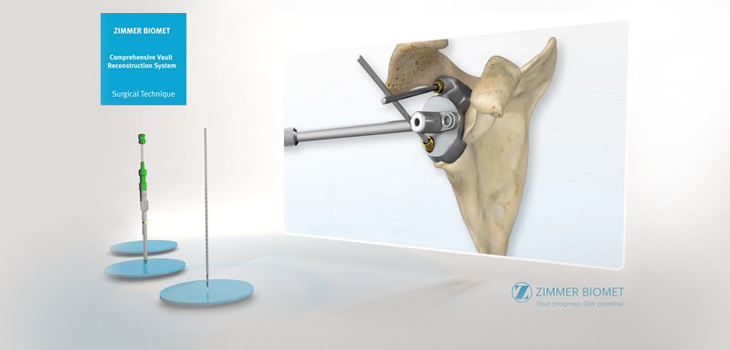
Zimmer Biomet Holdings, Inc. has introduced a personalized shoulder implant called the Comprehensive Vault Reconstruction System (VRS) for patients with a severely deficient rotator cuff and extensive bone loss which precludes the use of a standard glenoid baseplate.
Personalized Shoulder Reconstruction Implant From Zimmer Biomet
2 min read Premium comments
Secondary
Until now, treatment options for extensive glenoid deficiencies were limited to bone grafting or hemi-arthroplasty, said David Dines, M.D. an orthopedic surgeon at the Hospital for Special Surgery in New York. Dr. Dines is also a professor of orthopedic surgery at Weill Cornell Medical College. Dines said the previous treatment options were “unreliable and had marginal success.”
CT Imaging and 3D Technique
The VRS uses CT imaging and advanced 3D reconstruction techniques to allow surgeons to personalize each patient’s implant.
In a November 17, 2016 company press announcement, Dines said the system “represents an important advance in shoulder reconstruction by streamlining and personalizing the implant procedure in hope of more predictable outcomes and results that extend beyond pain relief, to restoring function and improving overall quality of life.”
Stephen Brockmeier, M.D., performed the first VRS implantation on September 21, 2016, at the University of Virginia Hospital in Charlottesville, Virginia.
The VRS was cleared by the FDA May 2016, just eight months after Biomet Manufacturing Corp. filed a 510k premarket notification of intent to market the system with the agency.
Indications
According to the FDA substantial equivalent determination, the system is indicated for use “in patients whose shoulder joint has a grossly deficient rotator cuff with severe arthropathy and/or previously failed shoulder joint replacement with a grossly deficient rotator cuff. The patient must be anatomically and structurally suited to receive the implants and a functional deltoid muscle is necessary.
“The [system] is indicated for primary, fracture, or revision total shoulder replacement for the relief of pain and significant disability due to gross rotator cuff deficiency.
“Comprehensive Vault Reconstruction System glenoid baseplate components are intended for cementless application with the addition of screw fixation in patients with unusual anatomy and/or extensive bone loss which precludes the use of a standard glenoid baseplate component.
“Titanium glenospheres are intended for patients with Cobalt Alloy material sensitivity. The wear of these devices has not been tested but, based on pin on disk testing, the wear rate is inferior to that of cobalt alloy glenospheres. A Cobalt Alloy glenosphere is the recommended component for reverse shoulder arthroplasty patients without material sensitivity to cobalt alloy.
“Interlok finish humeral stems are intended for cemented use and the MacroBond coated humeral stems are intended for press-fit or cemented applications. Humeral components with porous coated surface coating are indicated for either cemented or uncemented biological fixation applications.”
Orsa Britton, vice president and general manager of Zimmer Biomet’s global extremities business, said this patient-specific implant, coupled with extensive pre-operative planning software, “will expand viable treatment options for patients with severe glenoid deformities.”
Author
React:
Discussion
This is a fascinating development. In my practice we've seen similar outcomes with the revised protocol. The key differentiator seems to be patient selection criteria. Has anyone else noticed the correlation with BMI thresholds?
Great point. I'd push back slightly on the conclusion, the sample size in the cited study is too small to draw population-level inferences. That said, the directional signal is compelling and worth a larger RCT.
We implemented a similar approach last year. Early results are promising but we're still gathering 12-month follow-up data. Happy to share our protocol if anyone is interested.
Join the conversation
Orthopedic professionals are discussing this. Sign in and upgrade to read every comment and add your voice.