
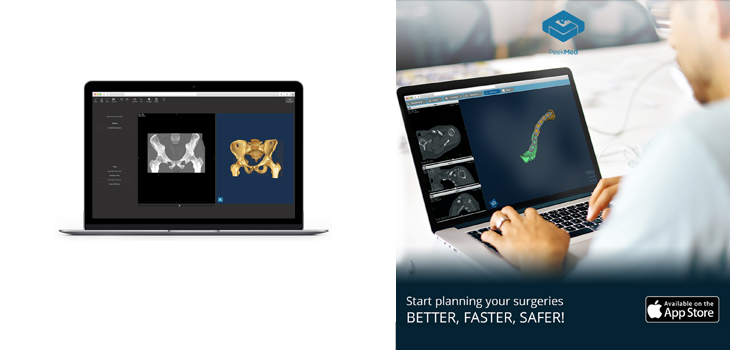
The PeekMed app, a way for surgeons to check on surgical planning from anywhere, is now available on the App Store. PeekMed, a company based in Braga, Portugal, indicates that its patent-pending technology means that surgeons can check and present patient plans and images exported from the PeekMed desktop software.
PeekMed Now on App Store
1 min read Premium comments
Secondary
According to the October 20, 2016 news release, “Using PeekMed a surgeon can reduce up to 20% of the surgery time and increase the accuracy of the team by analyzing the patient’s lesion in different angles. The hospital can reduce the sterilization costs in average 50% per surgery.”
Professor José Carlos Noronha is the physician for several high level athletes such as Cristiano Ronaldo and Radamel Falcao. Dr. Noronha said, “This is a game changer for the orthopedic community. It effectively allows the planning of traumatic and non-traumatic surgery with the support of the 3D reconstruction.”
“PeekMed gives access to pre and post-operative images; information about planned procedures and materials; 2D and 3D images and planning reports; and allows surgeons to comfortably review and effectively communicate what they have planned with their team and their patient for more predictable outcomes.”
João Pedro Ribeiro, CEO of PeekMed, told OTW, “At PeekMed we work every day to bring to orthopaedic surgeons the best products to help them during the planning process. PeekMed developed this iPad version to give surgeons a way to discuss and present his planning to the patient and the surgical team. This version has a 3D visualization window to better understand the final result, a 2D window to review the patient’s medical imaging and a report window with a lot of information. We at PeekMed hope this tool to be effective and helpful during the interaction with the patient and during the surgery itself.”
“In order to continue to deliver our vision to our customers, PeekMed will improve its Desktop and iPad version to be more and more a way to plan orthopaedic surgeries anywhere, anytime, because we believe in less surprises, less trouble.”
Author
React:
Discussion
This is a fascinating development. In my practice we've seen similar outcomes with the revised protocol. The key differentiator seems to be patient selection criteria. Has anyone else noticed the correlation with BMI thresholds?
Great point. I'd push back slightly on the conclusion, the sample size in the cited study is too small to draw population-level inferences. That said, the directional signal is compelling and worth a larger RCT.
We implemented a similar approach last year. Early results are promising but we're still gathering 12-month follow-up data. Happy to share our protocol if anyone is interested.
Join the conversation
Orthopedic professionals are discussing this. Sign in and upgrade to read every comment and add your voice.