
Pan Medical Corporation is announcing the receipt of 510(k) approval for the InterV Flex and the InterV Micro vertebral augmentation systems. According to the November 1, 2016 news release, “The InterV Flex is a curved needle and pre-curved balloon for use in vertebral augmentation procedures. The nitinol Flex needle is used to cross midline and create a void in the vertebral body as well as deliver cement. The first kyphoplasty pre-curved balloon unique to Pan Medical can then be inserted to follow the path created by the nitinol needle. In addition, Pan Medical is the first company to offer surgeons the unique option to use the new 510(k) cleared 13 gauge InterV Micro balloon catheter and insert this through the InterV Flex nitinol needle. Afterwards, the curved needle is then used as a curved cement delivery device…”
Pan Medical: 510(k) Clearance for InterV Flex, InterV Micro
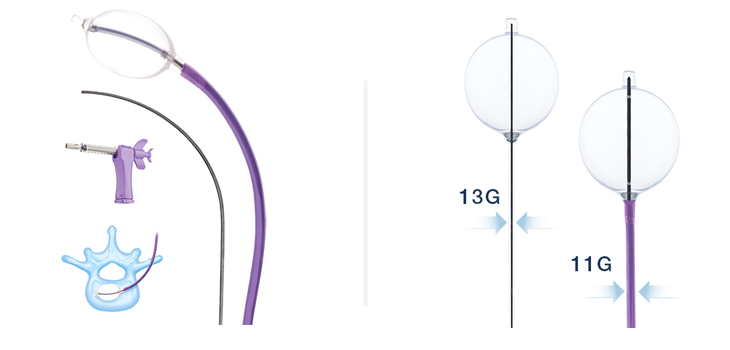
Company National Sales and Product Manager Chase Dickerson told OTW, “Creating the InterV Micro was a challenge as we had to work with the rigidity of the shaft to pass through a true 13 gauge cannula. Through our years of balloon manufacturing experience we were able to implement our newest technology along with laser welding to extrude a thinner balloon wall to overcome this profile handicap.”
“A great milestone with the InterV Flex curved needle, is the ability for it to work in conjunction with the 13 gauge balloon creating the most precise, accurate and quickest atraumatic way to perform a kyphoplasty procedure. This single device creates a void, allows for balloon deployment and cement delivery.”
Asked where they hope to “be” one year from now with these, he commented, “We continue to progress into the interventional radiology market with new products currently under FDA review and continuing to make kyphoplasty a more minimally invasive procedure.”
Discussion
This is a fascinating development. In my practice we've seen similar outcomes with the revised protocol. The key differentiator seems to be patient selection criteria. Has anyone else noticed the correlation with BMI thresholds?
Great point. I'd push back slightly on the conclusion, the sample size in the cited study is too small to draw population-level inferences. That said, the directional signal is compelling and worth a larger RCT.
We implemented a similar approach last year. Early results are promising but we're still gathering 12-month follow-up data. Happy to share our protocol if anyone is interested.
Join the conversation
Orthopedic professionals are discussing this. Sign in and upgrade to read every comment and add your voice.