
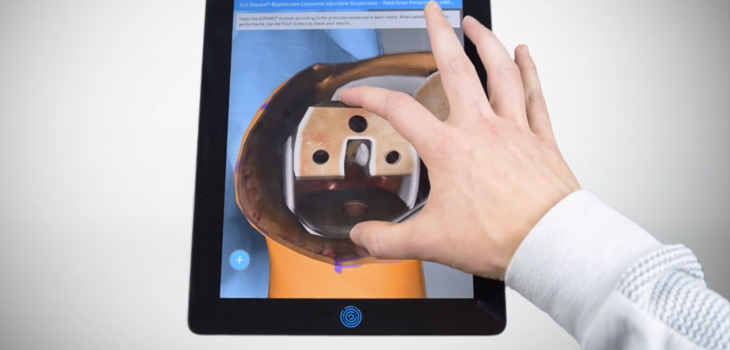
Gaming and knee surgery…what could be more natural? Well, now, Pacira Pharmaceuticals, Inc. launched a virtual reality simulation as well as a unique gaming experience to enhance administration technique for EXPAREL (bupivacaine liposome injectable suspension) in total knee arthroplasty (TKA).
Pacira, Touch Surgery Launch VR Simulation, Gaming Experience
2 min read Premium comments
Secondary
According to the November 11, 2016 news release, Pacira’s new virtual reality training tool utilizes real-time haptic feedback technology to create a realistic surgical experience in a risk free computer-generated surgical environment. To develop the platform, Pacira worked with a steering committee of orthopedic surgeons who are currently using EXPAREL postsurgical pain management.
A haptic stylus gives users the sensation of injecting EXPAREL into varying tissue layers and types. This kind of real-time feedback (combined with visual heat maps showing their actual infiltration results compared to the ideal distribution of EXPAREL throughout the surgical site) is a significant innovation in training.
Stan Dysart, M.D., an orthopedic surgeon at Wellstar Kennestone and Pinnacle Orthopaedics in Marietta, Georgia, is a steering committee member. He told OTW, “During the virtual reality experience the haptic tool enables the surgeon to experience sensory feedback while performing the injection, adding realism to this TKA procedure. The haptic technology allows the user to actually ‘feel’ the injection depth and the resistance while injecting the various tissues in a knee replacement model. For example, injection of pericapsular tissues feels uniquely different to the injection of subcutaneous fat, thus providing a realistic ‘operative’ experience.”
“Healthcare education remains a challenge because of the rapid increase in novel surgical and nonsurgical interventions in today’s rapidly changing environment, ” said Dysart. “Virtual reality is one solution to the rapidly changing and demanding educational requirements of healthcare providers. This particular simulation provides a rich, interactive and engaging experience that enables one to perform a TKA procedure in a risk-free environment while receiving immediate feedback.”
Pacira simultaneously launched a new virtual training engine developed in collaboration with the mobile training platform Touch Surgery. As described in the company’s press announcements, the unique gaming experience is the first of its kind. Furthermore, it comes a part of an extensive Touch Surgery library of modules and gives users on-demand ability to practice infiltrating.
Jean Nehme M.D., co-founder at Touch Surgery said, “Physicians have never experienced a level of interactive training like what we’ve built with Pacira. Our first pharmaceutical based procedure, this is our most innovative simulation to date leveraging a custom built 3D learning engine.”
Dr. Andre Chow, also a co-founder of Touch Surgery, told OTW, “The aim of the Touch Surgery platform is to help scale global surgery through the dissemination of surgical techniques and knowledge. With this new simulation we hope to help surgeons around the world improve their outcomes following knee arthroplasty.”
“We crafted an entirely new mobile experience for this simulation and developed brand new technology on the Touch Surgery platform—incorporating a real-time gaming engine to add even more functionality and realism to the simulation. This allows even more interaction than previously possible, permitting the user to adjust the angle and depth of injection into a number of important anatomical sites, as well as adjust viewpoints and completely rehearse the procedure before touching a patient. It is breaking a new barrier in terms of the realism that is possible from a mobile platform.”
Author
React:
Discussion
This is a fascinating development. In my practice we've seen similar outcomes with the revised protocol. The key differentiator seems to be patient selection criteria. Has anyone else noticed the correlation with BMI thresholds?
Great point. I'd push back slightly on the conclusion, the sample size in the cited study is too small to draw population-level inferences. That said, the directional signal is compelling and worth a larger RCT.
We implemented a similar approach last year. Early results are promising but we're still gathering 12-month follow-up data. Happy to share our protocol if anyone is interested.
Join the conversation
Orthopedic professionals are discussing this. Sign in and upgrade to read every comment and add your voice.