
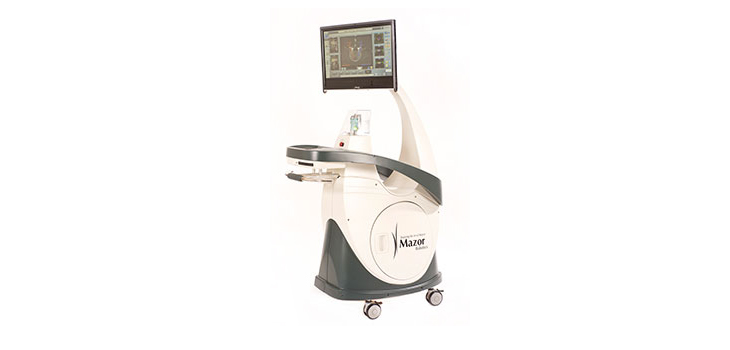
The Carolinas Medical Center Mercy was the site of a recent milestone: the 100th Mazor Robotics Ltd Renaissance spine surgical case. It was the OrthoCarolina Robotics Spine Surgery Team that had the honor of performing the case. According to the October 25, 2016 news release, the patient underwent a fusion procedure that involved inserting screws into the lumbar spine.
OrthoCarolina: 100th Case Using Mazor Robotics Renaissance
1 min read Premium comments
Secondary
“The Mazor Robotics Renaissance robot allows precise placement of pedicle screws in patients with difficult anatomy, such as those with scoliosis deformities. The screws can be placed minimally invasively, leading to lower patient morbidity, ” said Alden Milam, M.D., OrthoCarolina spine surgeon.
“Robotics increases the precision and consistency of what we do in the operating room. These are two of the most important qualities of any surgical procedure, ” said Eric Laxer, M.D., OrthoCarolina spine surgeon.
Dr. Laxer told OTW, “The software is used to virtually place the pedicle screws where they need to be when they plan pre-operatively on the CT. This is then sent to the robot during surgery.”
In addition to Drs. Milam and Laxer, the OrthoCarolina Spine Center Team includes surgeons Dr. Bruce Darden, Dr. Al Rhyne, Dr. Leo Spector, Dr. Brad Segebarth, and Dr. Matt Chapman.
Asked about upcoming plans, a company representative told OTW, “There will be a heavy focus on patient education with seminars and social media outreach. Also, we have signed a business agreement with Medtronic to assist in market development and awareness as robotics continues to escalate in popularity.”
React:
Discussion
This is a fascinating development. In my practice we've seen similar outcomes with the revised protocol. The key differentiator seems to be patient selection criteria. Has anyone else noticed the correlation with BMI thresholds?
Great point. I'd push back slightly on the conclusion, the sample size in the cited study is too small to draw population-level inferences. That said, the directional signal is compelling and worth a larger RCT.
We implemented a similar approach last year. Early results are promising but we're still gathering 12-month follow-up data. Happy to share our protocol if anyone is interested.
Join the conversation
Orthopedic professionals are discussing this. Sign in and upgrade to read every comment and add your voice.