
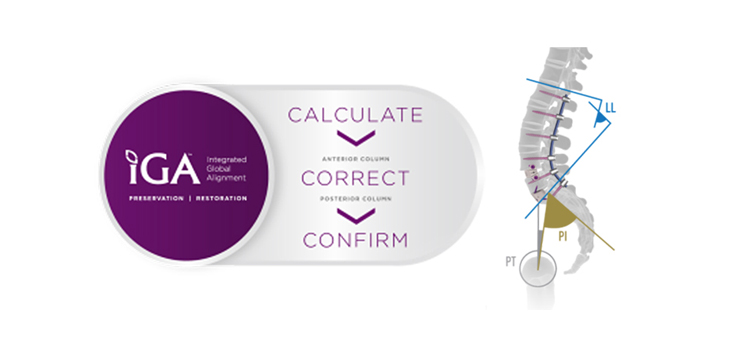
NuVasive, Inc. has just announced that its Integrated Global Alignment (iGA) platform now supports all spinal procedures, including cervical alignment. They have also introduced image enhancement software that allows the surgical staff to significantly reduce exposure to surgical radiation in the operating room (OR).
NuVasive: New Spine Technology Introductions
2 min read Premium comments
Secondary
As indicated in the October 25, 2016 news release, “iGA is a proprietary, procedurally-integrated digital platform of specialized products designed to help surgeons achieve more precise spinal column alignment…”
To address concerns about surgeon and patient radiation exposure, “NuVasive has acquired the LessRay software technology suite from a company called SafeRay Spine…”
Asked to give details on how the technology helps surgeons “calculate, correct, confirm, ” Jason Hannon, NuVasive’s president and chief operating officer, told OTW, “To optimize sagittal alignment prior to surgery, we have two software solutions to help surgeons calculate a patients pelvic parameters, Nuvaline and NuvaMap. Nuvaline is a mobile app that works on the iOS platform, with an Android version to come, and NuvaMap is computer based software which provides a more enhanced version of calculating these same parameters. NuvaMap takes the software step further by allowing a surgeon to simulate different surgical options to understand in advance, how different approaches or interbody devices might affect the outcome on a patient’s parameters.
“Once a surgeon understands the patient’s alignment and establishes their treatment plan, they use NuVasive’s full line of hyper-lordotic cages in both lumbar and cervical. These options help achieve the correction they set during the planning phase. In addition to interbody, NuVasive offers rod and screw systems to combine with the interbody for a total fixation solution.”
“There are two points in the process to confirm the achievement of sagittal alignment: during the case (intraoperative) and post-surgery. A surgeon can then put trials and eventually cages into a chosen disc space(s) and use a standard fluoroscopic images imported into NuvaMap to confirm how much correction they achieved at a specific place in the spine. Following the procedure, the surgeon imports film into NuvaMap for their post-op evaluation. By measuring it once again, the surgeon confirms that they achieved the alignment that they planned for.”
“To establish proper alignment, surgeons can calculate parameters to understand alignment and surgical goals, make the necessary correction with our interbody and fixation portfolio and confirm they achieved what they set out to do.
“LessRay is a visual enhancement software system that is based off of one normal dose c-arm image, allowing a user to manually turn down the level of radiation [milliamperage second-mAs] on the c-arm. Traditionally, this renders the image quality to almost useless, depending on how much it is turned down. LessRay software reconstitutes the image and restores what the surgeon sees back to the original quality on the LessRay monitor right in the operating room. This innovation allows a reduction in the amount of radiation needed to achieve good quality images, exposing the surgeon, the staff and patient to a far lower level of radiation. We evaluated 24 cases in preparation for the FDA tracking submission and were able to reduce radiation by 97%.”
React:
Discussion
This is a fascinating development. In my practice we've seen similar outcomes with the revised protocol. The key differentiator seems to be patient selection criteria. Has anyone else noticed the correlation with BMI thresholds?
Great point. I'd push back slightly on the conclusion, the sample size in the cited study is too small to draw population-level inferences. That said, the directional signal is compelling and worth a larger RCT.
We implemented a similar approach last year. Early results are promising but we're still gathering 12-month follow-up data. Happy to share our protocol if anyone is interested.
Join the conversation
Orthopedic professionals are discussing this. Sign in and upgrade to read every comment and add your voice.