
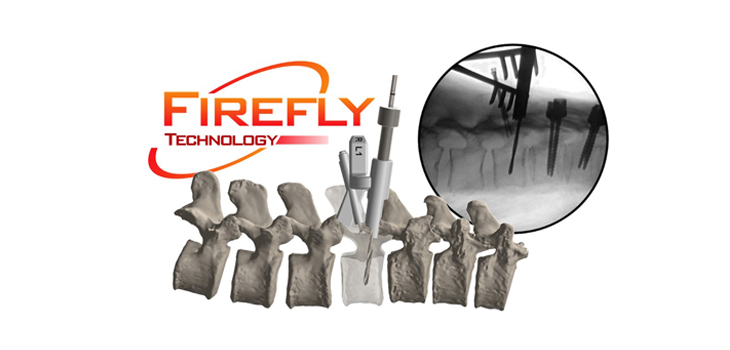
Mighty Oak Medical is spreading its branches with the news of its second FDA clearance for its 3D printed FIREFLY Pedicle Screw Navigation Guides. This essentially extends compatibility to all currently cleared pedicle screw systems. The new clearance also extends the indications for use to T1-S2/ilium. The company indicates that by choice, Mighty Oak does not have its own proprietary screw system, and is actively collaborating with strategic channel partners.
Mighty Oak Medical: Second FDA Clearance for FIREFLY
2 min read Premium comments
Secondary
As state in the November 7, 2016 news release, “FIREFLY does not require an upfront capital expenditure and is single-use and scalable. It features concierge pre-surgical planning by trained engineers, an autoclavable bone model, predetermined screw sizing, surgeon-approved preselected trajectories, an intraoperative plan, and 3D printed patient-specific guides to mechanically constrain the drill and tap to follow the preselected trajectories. FIREFLY is highly accurate and limits intraoperative radiation exposure; in 10 of 14 recent FIREFLY surgeries, no fluoroscopy was used for drilling, tapping or pedicle screw placement. The system does not disrupt surgical flow and is designed to increase OR efficiency. It is also the only patient-specific pedicle screw guide indicated for use in pediatric patients.”
“FIREFLY Technology should also be able to help hospitals faced with scheduling conflicts for their current navigation systems. By being open platform and compatible with essentially all currently cleared pedicle screw systems, these patented 3D printed patient-specific guides are an exciting new option on the navigation menu.”
Asked how exactly this system aids in scheduling, Mighty Oak President Heidi Frey told OTW, “FIREFLY Patient Specific Pedicle Screw Navigation Guides are a single-use and 3D printed form of navigation. As such, there can never be a scheduling conflict. Million dollar navigation systems, such as computer assisted surgical navigation and robotics, can only be booked by one surgeon at a time, potentially creating a navigation bottleneck. For surgeons and hospitals faced with scheduling conflicts, FIREFLY offers a solution that facilitates multiple surgeries taking place concurrently. For hospitals with small budgets or low spinal surgery volumes, where it is not feasible to acquire a capital-intensive navigation system, FIREFLY Guides also offer a solution. FIREFLY Guides tested at unsurpassed screw placement accuracy, and are FDA cleared with essentially all screw systems.”
“Every spine is unique, and every 3D printed FIREFLY Guide is customized to match each vertebra. FIREFLY provides a concierge presurgical plan that is created using a three-dimensional, exact replica of the patient’s spine. Every screw trajectory is carefully planned for that patient, and the plan is implemented in the OR when the surgeon uses Guides that mechanically constrain the drill and tap to those pre-selected trajectories. A surgeon’s confidence and accuracy can be greatly enhanced with the power of patient-specific, personalized planning. Additionally, the virtual spine is 3D printed as an anatomically precise and autoclavable bone model, which is provided to the surgeon for use in the OR and for patient education purposes.”
Author
React:
Discussion
This is a fascinating development. In my practice we've seen similar outcomes with the revised protocol. The key differentiator seems to be patient selection criteria. Has anyone else noticed the correlation with BMI thresholds?
Great point. I'd push back slightly on the conclusion, the sample size in the cited study is too small to draw population-level inferences. That said, the directional signal is compelling and worth a larger RCT.
We implemented a similar approach last year. Early results are promising but we're still gathering 12-month follow-up data. Happy to share our protocol if anyone is interested.
Join the conversation
Orthopedic professionals are discussing this. Sign in and upgrade to read every comment and add your voice.