
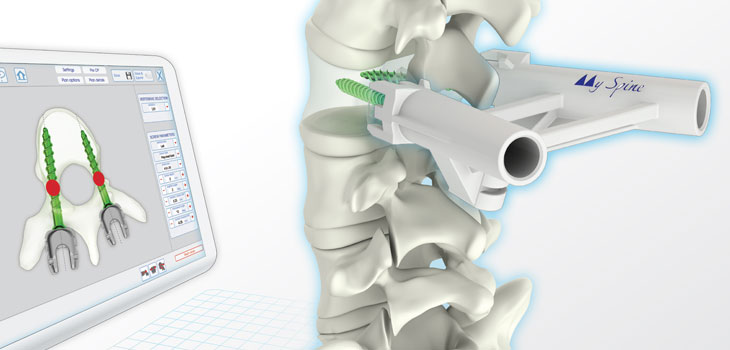
Medacta International has announced the successful completion of the first U.S. surgeries by Raymond Golish, M.D., Ph.D., in Jupiter, Florida, and Arnold Vardiman, M.D., in San Antonio, Texas, utilizing its proprietary 3D-printed MySpine Low Profile Guide. The product received 501(k) clearance from the U.S. Food and Drug Administration in August 2016.
Medacta: First U.S. Surgeries With MySpine
2 min read Premium comments
Secondary
“My work requires me to stay on the leading edge of new technologies and techniques for minimally invasive surgery, ” Dr. Golish stated in the October 26, 2016 news release. “The MySpine Low Profile Guide sets a new standard for spine surgery and is well-positioned for safe, reproducible results in less invasive instrumentation of the lumbar and thoracic spine. With the simple, yet thorough preoperative planning and 3D-printed spine guides, I was able to decrease overall operating room time and have better confidence in visualizing the screw trajectory while reducing the need for CT radiation. The patient from my first case is doing very well.”
Drs. Golish and Vardiman also utilized Medacta’s M.U.S.T. Pedicle Screw System, which requires only one set of dedicated instruments compatible with percutaneous, mini-open, and open procedures.
“Our MySpine Low Profile Guide marks another step forward in Medacta’s continued focus on procedural innovation in spine surgery and adds to Medacta’s already impressive and extensive spine portfolio, ” said Francesco Siccardi, executive vice president of Medacta International. “The Medacta difference stems from the strong emphasis we place on surgeon training and education, as well as better procedural focus to simplify the complex nature of spine procedures.”
Asked about comments they received while presenting the MySpine Low Profile Guide at the recent North American Spine Society (NASS) meeting, company representatives told OTW, “Very innovative; unique and visionary technology; addresses current challenges that exist while pre-operative planning cases; surgeons see where it would reduce radiation exposure for patients.”
Siccardi commented to OTW, “The primary mission of Medacta is to minimize the frustrations and concerns of spine surgeons by providing unprecedented educational and clinical support when starting with MySpine. A team of experienced surgeon educators has created a comprehensive curriculum for monthly educational meetings that provide attendees with detailed procedural overviews, cadaver training and solutions to multiple clinical challenges. Beyond that exposure, and if additional clinical support is requested, Medacta will provide a surgeon proctor to support a new user’s first cases.”
Author
React:
Discussion
This is a fascinating development. In my practice we've seen similar outcomes with the revised protocol. The key differentiator seems to be patient selection criteria. Has anyone else noticed the correlation with BMI thresholds?
Great point. I'd push back slightly on the conclusion, the sample size in the cited study is too small to draw population-level inferences. That said, the directional signal is compelling and worth a larger RCT.
We implemented a similar approach last year. Early results are promising but we're still gathering 12-month follow-up data. Happy to share our protocol if anyone is interested.
Join the conversation
Orthopedic professionals are discussing this. Sign in and upgrade to read every comment and add your voice.