
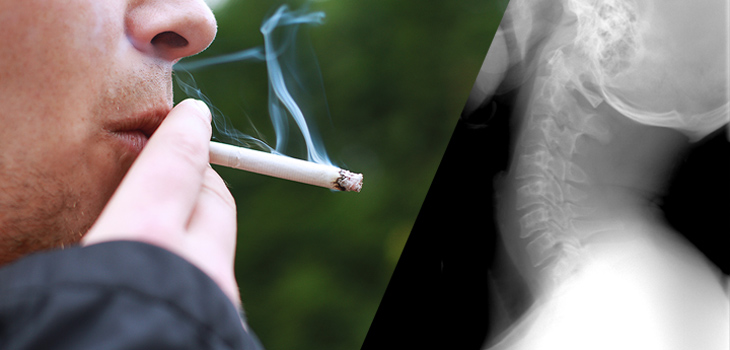
A new study selected as a “Best Paper” at the 31st Annual Meeting of the North American Spine Society (NASS) indicates that tobacco use may interfere with the body’s healing response from cervical myelopathy surgery…and that this is based on number of cigarettes smoked over a lifetime.
Lifetime Cigarette Use Affects Spine Healing
1 min read Premium comments
Secondary
“While it is well-established that smoking compromises healing from spine surgery, this new study suggests that improvement is actually tobacco dose dependent, ” said Alan S. Hilibrand, M.D., an orthopedic surgeon and 2016 NASS Annual Meeting Program Chair, in the October 26, 2016 news release. “This study gives spine specialists important data to help them counsel patients to quit smoking as early as possible.”
“We found that tobacco use was directly correlated with decreased postoperative improvement in Nurick score, ” said David Kusin, M.D., of the University of Nebraska Medical Center in Omaha, a co-author on the study. “Specifically, the mean improvement in Nurick score was almost one point lower in smokers than in nonsmokers.”
“These data suggest that patients with cervical myelopathy who smoke are likely to have less improvement in their condition postoperatively, compared to those who do not smoke, and that the effect of each cigarette is additive, ” Dr. Kusin said. “These findings reinforce the importance of counseling patients about smoking cessation prior to surgery.”
Dr. Kusin told OTW, “It was not surprising to find that smokers did not do as well as nonsmokers. Likewise, the dose response relationship between tobacco use and poorer outcomes was not unexpected. However, our finding that tobacco use did not correlate with the severity of myelopathy preoperatively was somewhat unexpected and perhaps a bit counterintuitive.”
“The results of our study emphasize the importance of counseling patients about smoking cessation in general, and before surgery in particular. Further work will be needed to identify the optimal duration of smoking cessation preoperatively that will allow for the best outcomes.”
Author
React:
Discussion
This is a fascinating development. In my practice we've seen similar outcomes with the revised protocol. The key differentiator seems to be patient selection criteria. Has anyone else noticed the correlation with BMI thresholds?
Great point. I'd push back slightly on the conclusion, the sample size in the cited study is too small to draw population-level inferences. That said, the directional signal is compelling and worth a larger RCT.
We implemented a similar approach last year. Early results are promising but we're still gathering 12-month follow-up data. Happy to share our protocol if anyone is interested.
Join the conversation
Orthopedic professionals are discussing this. Sign in and upgrade to read every comment and add your voice.