
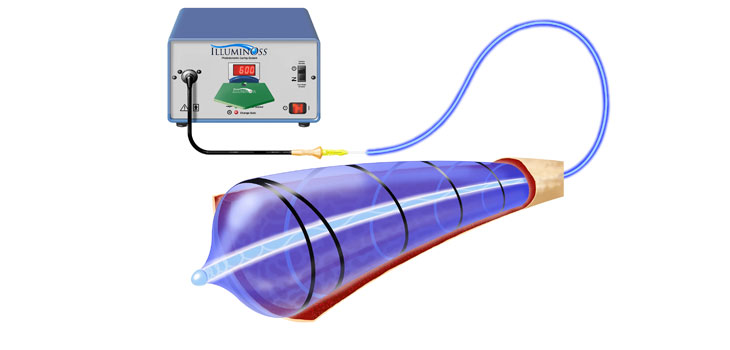
Richard Terek, M.D. has just presented preliminary data on IlluminOss Medical’s LightFix trial at the recent Musculoskeletal Tumor Society (MSTS) Meeting in Detroit. According to the company, the multicenter study looks at “the IlluminOss System for the treatment of impending and actual pathological fractures in the humerus from metastatic bone disease. Preliminary results from the U.S. trial measured pain and functional improvement, as well as evaluated safety and performance.”
IlluminOss : Promising Data on LightFix
2 min read Premium comments
Secondary
Patients were treated at Rhode Island Hospital by Dr. Terek, an orthopedic surgeon and musculoskeletal oncologist who specializes in reconstructive surgery and musculoskeletal oncology, and professor in the department of orthopedic surgery at The Warren Alpert Medical School of Brown University.
“The investigators found that the technical nature and attributes of the product were viewed to be easier and faster to use, with no limitations to the use of adjunctive hardware, ” said Dr. Terek in the November 1, 2016 news release.
“The preliminary results of the LightFix trial have been extremely positive in that the investigators found that the device was less invasive than many standard orthopedic implants. The early data suggests that the patients achieved a decrease in pain and an increase in return to function through the use of the IlluminOss implant, ” said Dr. Terek. “We are encouraged with the results of the IlluminOss System and look forward to its availability in the USA. It will offer the U.S. market a new and much-needed alternative for the treatment of patients with metastatic bone disease and other complex fractures.”
“This first presentation of our clinical data is consistent with the positive results we have seen in Europe and is further substantiation of the merits of our platform’s capabilities and how they may benefit the orthopedic community, ” said IlluminOss CEO Manny Avila. “We look forward to the presentation of the completed LightFix trial results and the opportunity to provide the product to a much broader patient base.”
Dr. Terek told OTW, “What I found most intriguing was the willingness of patients to try a new product and of orthopedic surgeons to participate in a trial that approaches pathological fracture repair in a way that is very different from existing traditional methods. This seems to speak to the market’s need—and readiness—for alternate approaches to treating complex fractures.”
“There have been very positive results achieved from use of the IlluminOss System in international markets already and, pending FDA approval, this technology could allow orthopedic surgeons in the U.S. to treat fractures due to metastatic bone disease—and other conditions—in new and better ways. The technique allows for intramedullary stabilization of the humerus without violating the rotator cuff insertion.”
Author
React:
Discussion
This is a fascinating development. In my practice we've seen similar outcomes with the revised protocol. The key differentiator seems to be patient selection criteria. Has anyone else noticed the correlation with BMI thresholds?
Great point. I'd push back slightly on the conclusion, the sample size in the cited study is too small to draw population-level inferences. That said, the directional signal is compelling and worth a larger RCT.
We implemented a similar approach last year. Early results are promising but we're still gathering 12-month follow-up data. Happy to share our protocol if anyone is interested.
Join the conversation
Orthopedic professionals are discussing this. Sign in and upgrade to read every comment and add your voice.