
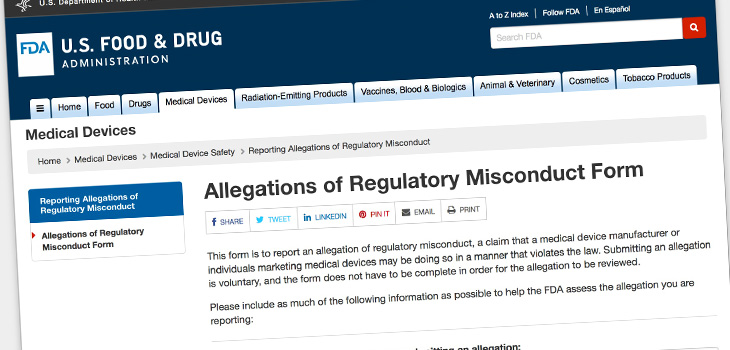
On October 21, 2016, the FDA launched a new website for reporting alleged regulatory misconduct by medical device makers.
FDA Sets Up “Allegations of Regulatory Misconduct” Website
2 min read Premium comments
Secondary
The agency made the move after a report came out in the Minneapolis Star-Tribune which revealed that the FDA has accepted late adverse event reports from device companies for hundreds of thousands of incidents.
Any person will now able to go to website called, Allegations of Regulatory Misconduct (www.fda.gov/MedicalDevices/Safety/ReportingAllegationsofRegulatoryMisconduct/ucm526129.htm) and submit a claim if you believe a device manufacturer or anyone marketing devices may be doing so in a manner that violates the law.
According to the FDA, allegations of regulatory misconduct may include failure to register and list a medical device, marketing uncleared or unapproved products, failure to follow quality system requirements, or misleading promotion. Below are some examples of the kind of allegations the FDA has received.
Examples of Allegations
- “Promotion or advertising of a device outside the FDA-cleared or approved indications for use.
- A device manufacturer fails to submit required reports to the FDA for device-related safety concerns, and/or is not conducting required follow up investigations per the regulatory requirements.
- A company’s medical devices or manufacturing processes do not meet their design and manufacturing responsibilities.
- Marketing a medical device without the appropriate FDA clearance (510(k)) or approval (PMA).
- A manufacturer imports medical devices into the United States that do not meet legal requirements for admission to the U.S.
- A third party outside the medical device company forges or falsifies an export certificate to bring medical devices into the U.S.
- A company fails to register and list their medical device products with the FDA, preventing the FDA from having required information about a device on the market.
- A manufacturer knowingly deceives the FDA. For example, the manufacturer hides information from the FDA, or falsifies documents, etc. given to the FDA.”
The allegations are reviewed by the Center for Devices and Radiological Health (CDRH). CDRH prioritizes the review of allegations based on the level of potential risks, within the context of an overall benefit-risk profile, to patients.
If you want to know what happened to your report, you must submit a request under the Freedom of Information Act (FOIA). The FOIA does not require agencies to create new records or to conduct research, analyze data, or answer questions submitted as FOIA requests for records.
Because investigating the allegations will take time, the agency recommends waiting at least 180 days after submitting allegations to the FDA before submitting a FOIA request for related records.
Author
React:
Discussion
This is a fascinating development. In my practice we've seen similar outcomes with the revised protocol. The key differentiator seems to be patient selection criteria. Has anyone else noticed the correlation with BMI thresholds?
Great point. I'd push back slightly on the conclusion, the sample size in the cited study is too small to draw population-level inferences. That said, the directional signal is compelling and worth a larger RCT.
We implemented a similar approach last year. Early results are promising but we're still gathering 12-month follow-up data. Happy to share our protocol if anyone is interested.
Join the conversation
Orthopedic professionals are discussing this. Sign in and upgrade to read every comment and add your voice.