
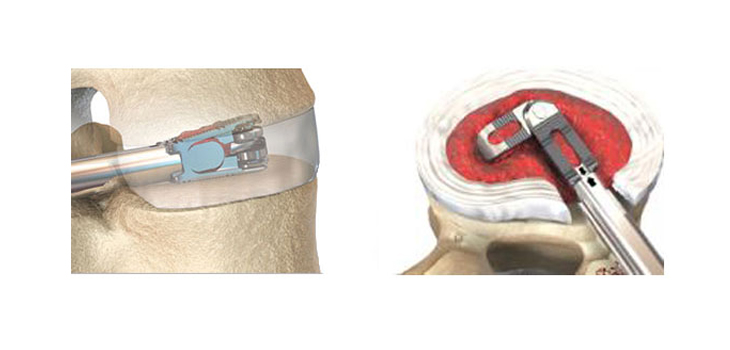
Expanding Orthopedics Inc. (EOI) has announced that the company has been granted its 14th U.S. Patent, covering its 3D expandable cage technology integrated in the FLXfit.
Expanding Orthopedics: U.S. Patent 3D Expandable Cage
1 min read Premium comments
Secondary
Mark M. Levy, M.D., an orthopedic surgeon, CTO and founder of EOI said in the November 14, 2016, “This new patent recognizes the unique innovation of our 3D expandable cage, the FLXfit.” He explains that, “This patent refers to the multiple segments design with its articulation mechanism and the unique angular expansion for dial-in lordosis correction, conforming to the patient’s anatomy and level treated.”
Dr. Levy told OTW, “The surgeons should know this new device finally offers them an effective tool to correct the sagittal alignment (lumbar lordosis) even through an MIS [minimally invasive surgery] approach. It enables them to use an interbody cage through one portal TLIF [transforaminal lumbar interbody fusion] with substantial footprint and bone graft area. These unique features will help them obtain the best outcome for their patients. The most interesting challenge was to maximize the device engineering to provide simplicity, user-friendly experience and optimal performance.”
Ofer Bokobza, EOI’s CEO, commented in the news release, “This new patent grant is an important addition to our broad IP [intellectual property] portfolio, demonstrating our continuous commitment to innovation and our ability to develop state-of-the-art devices addressing unmet clinical designed to improve patients’ outcome”. He concludes that, “We are working diligently on a rich product pipeline with unique IP which will reinforce our position as a fast growing expandable devices’ spine company.”
Author
React:
Discussion
This is a fascinating development. In my practice we've seen similar outcomes with the revised protocol. The key differentiator seems to be patient selection criteria. Has anyone else noticed the correlation with BMI thresholds?
Great point. I'd push back slightly on the conclusion, the sample size in the cited study is too small to draw population-level inferences. That said, the directional signal is compelling and worth a larger RCT.
We implemented a similar approach last year. Early results are promising but we're still gathering 12-month follow-up data. Happy to share our protocol if anyone is interested.
Join the conversation
Orthopedic professionals are discussing this. Sign in and upgrade to read every comment and add your voice.