
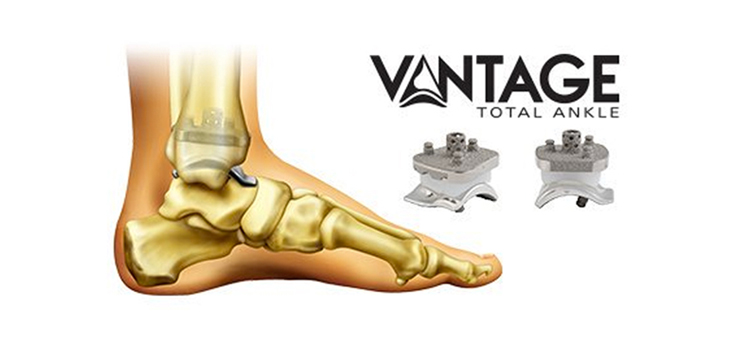
Exactech, Inc. has announced that Duke University surgeons have performed the first surgery using its new Vantage Total Ankle System.
Exactech: First Surgery With Vantage Total Ankle System
2 min read Premium comments
Secondary
Orthopedic surgeons Mark Easley, M.D., and James Nunley, M.D. have done the first case with the ankle implant in Durham, North Carolina. “The surgical team and I were pleased that the Vantage Total Ankle replacement went exactly according to plan, ” Dr. Easley said in the October 13, 2016 news release. “After several years of thoughtful development and design, the anatomic implants, practical instrumentation and relatively simple technique performed as they were designed. Based on proprietary anatomic data, the Exactech Vantage Total Ankle team of surgeons and engineers developed an innovative total ankle design that features both anatomic talar and tibial components.”
Dr. Easley also added, “The technique, with its favorable tibial and talar bone preparation which was clearly designed with minimal bone resection in mind, affords optimal support for the anatomically shaped implants. The Vantage Total Ankle has a reproducible and surgeon-friendly technique.”
Exactech Vice President of Extremities Marketing Darin Johnson said, “We had the privilege to design this product with some of the best thought leaders in the world who have dedicated their careers to the treatment of the ankle. Our team is proud to be a part of successfully improving the surgical outcome for one patient and laying the foundation for many, many more in the years to come. This marks a strategic expansion into the foot and ankle market where we will leverage Exactech’s founding principle of solving clinical challenges in collaboration with surgeons in order to improve the lives of patients. It is an exciting time.”
Exactech and a design team of esteemed surgeons designed the product, including: James Nunley, M.D.; James DeOrio, M.D.; and Mark Easley, M.D., of Duke University in Durham, North Carolina; and Victor Valderrabano, M.D., Ph.D., of Swiss Ortho Center of Schmerzklinik Basel in Basel, Switzerland.
Dr. Nunley told OTW, “Although currently available ankle prostheses have shown increased longevity, they have not approached the results for hip and knee replacement. We believed that a prosthetic device should be more anatomically designed. If you duplicate anatomy as we have with other joints we should be able to improve function and longevity. We believe that this prosthesis represents a significant improvement in anatomic design which hopefully will lead to greater function and longevity for the patient.”
“We studied many CT scans of ankles to determine the optimum anatomic configuration for our prostheses. We also wanted to minimize bone resection to enhance fixation of the device.”
Author
React:
Discussion
This is a fascinating development. In my practice we've seen similar outcomes with the revised protocol. The key differentiator seems to be patient selection criteria. Has anyone else noticed the correlation with BMI thresholds?
Great point. I'd push back slightly on the conclusion, the sample size in the cited study is too small to draw population-level inferences. That said, the directional signal is compelling and worth a larger RCT.
We implemented a similar approach last year. Early results are promising but we're still gathering 12-month follow-up data. Happy to share our protocol if anyone is interested.
Join the conversation
Orthopedic professionals are discussing this. Sign in and upgrade to read every comment and add your voice.