
There really aren’t many awards that Freddie Fu, M.D. has NOT received during his distinguished career at the University of Pittsburgh. But a few of his ardent admirers have found a new way to honor him. Dr. Fu has been appointed as a Distinguished Service Professor and on November 3, 2016 he presented the Dr. Freddie Fu Inaugural Lecture.
Dr. Freddie Fu Inaugural Lecture as Distinguished Service Professor
1 min read Premium comments
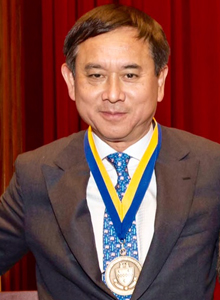
According to the November 3, 2016 news release, designation as a Distinguished Service Professor recognizes distinctive contributions and a high-level of dedication to the university community, as well as performance excellence and national stature in their field or discipline.
Dr. Fu told OTW, “It is a tradition for distinguished faculty members to present an inaugural lecture to celebrate their appointment. I was honored to deliver my Inaugural Distinguished Professorship Lecture entitled, ‘60 Years of Orthopaedic Research in Pittsburgh.’”
“I was pleased to share many memories with the audience, including photographs taken around Pittsburgh and on the Pitt campus, highlights of my travels from Hong Kong to Dartmouth to Pittsburgh, how I met my dear wife. I shared family stories about his great-uncle who was involved in signing the Moscow treaty for China, a precursor to the United Nations, as well as about his wife who belonged to an all-girls singing group in Hong Kong. I proudly noted the research of Bob Greer and George Bentley who were conducting studies of cartilage cell growth with transplantation into defects. This pioneering work would be published in the prestigious journal, Nature, at least 25 years before research in cell therapy became prevalent. I also let the audience know about the pleasures of working with the Pittsburgh Ballet…and I gave a brief demonstration of my dancing skills!”
Author
React:
Discussion
This is a fascinating development. In my practice we've seen similar outcomes with the revised protocol. The key differentiator seems to be patient selection criteria. Has anyone else noticed the correlation with BMI thresholds?
Great point. I'd push back slightly on the conclusion, the sample size in the cited study is too small to draw population-level inferences. That said, the directional signal is compelling and worth a larger RCT.
We implemented a similar approach last year. Early results are promising but we're still gathering 12-month follow-up data. Happy to share our protocol if anyone is interested.
Join the conversation
Orthopedic professionals are discussing this. Sign in and upgrade to read every comment and add your voice.