
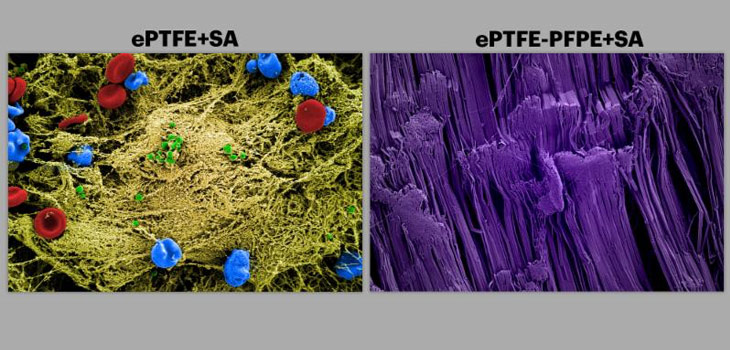
A carnivorous plant is inspiring scientists to advance bacterial resistance on implants. A team of researchers led by Joanna Aizenberg, Ph.D., and Elliot Chaikof, M.D., Ph.D., at the Wyss Institute for Biologically Inspired Engineering and the Harvard John A. Paulson School of Engineering and Applied Sciences at Harvard University (SEAS), as well as the Beth Israel Deaconess Medical Center (BIDMC), has, according to the October 31, 2016 news release, “created self-healing slippery surface coatings with medical-grade teflon materials and liquids that prevent biofilm formation on medical implants while preserving normal innate immune responses against pathogenic bacteria.”
Carnivorous Plant Inspires Progress on Implant Coatings
2 min read Premium comments
Secondary
“The technology is based on the concept of ‘slippery liquid-infused porous surfaces’ (SLIPS) developed by Aizenberg, who is a Wyss Institute Core Faculty member, Professor of Chemistry and Chemical Biology and the Amy Smith Berylson Professor of Materials Science at SEAS. Inspired by the carnivorous Nepenthes pitcher plant, which uses the porous surface of its leaves to immobilize a layer of liquid water, creating a slippery surface for capturing insects, Aizenberg previously engineered industrial and medical surface coatings that are able to repel unwanted substances as diverse as ice, crude oil and biological materials.”
“SLIPS coatings yielded extremely favorable responses in vivo: they resisted infection by bacteria and were associated with considerably less infiltrating immune cells and inflammatory abscesses than non-coated ePTFE, ” said Dr. Chaikof, who is a Wyss Institute Associate Faculty member, Chairman of the Roberta and Stephen R. Weiner Department of Surgery and Surgeon-in-Chief at BIDMC.
“At present, patients who receive implants for the repair, reconstruction or replacement of diseased or damaged organs or tissues or otherwise depend upon temporary life sustaining support systems, often require antibiotics at the time of implantation to keep the risk of bacterial infection at bay. SLIPS coatings one day could obviate the widespread use of antibiotics, minimize the development of antibiotic resistant microorganisms, and enhance the capacity of temporary or permanent artificial devices to resist infection, ” said Dr. Chaikof.
Dr. Aizenberg told OTW, “When one goes from in vitro to in vivo, it is generally not known at all whether the outcome would be anywhere close to what one hopes it to be. So, we were really gratified that there was clearly less bacteria colonization in vivo, both on the surface of the implants and in the nearby tissue. But even more importantly, we were impressed to see that the innate immune response of the organism was not compromised, making the SLIPS coating really promising for this and other healthcare applications.”
“We have developed a broad portfolio of coating techniques that can be applied to various materials, including titanium and stainless steel—materials used for implants and surgical instrumentation. Our hope is that with sufficient interest and development effort, SLIPS will make it to a number of healthcare applications, including orthopedics.”
Author
React:
Discussion
This is a fascinating development. In my practice we've seen similar outcomes with the revised protocol. The key differentiator seems to be patient selection criteria. Has anyone else noticed the correlation with BMI thresholds?
Great point. I'd push back slightly on the conclusion, the sample size in the cited study is too small to draw population-level inferences. That said, the directional signal is compelling and worth a larger RCT.
We implemented a similar approach last year. Early results are promising but we're still gathering 12-month follow-up data. Happy to share our protocol if anyone is interested.
Join the conversation
Orthopedic professionals are discussing this. Sign in and upgrade to read every comment and add your voice.