
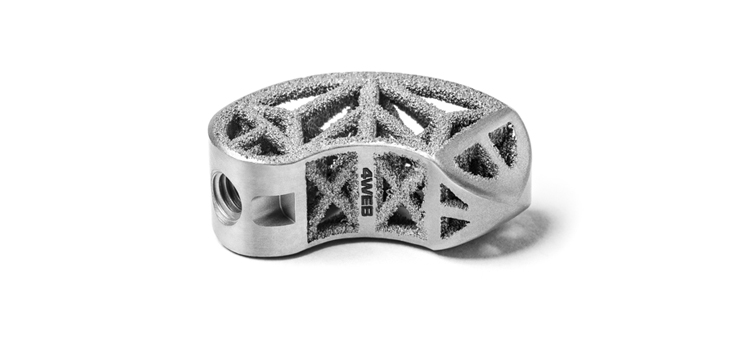
Cameron Carmody, M.D., of Texas Spine Consultants in Dallas stated in the October 27, 2016 news release, “The Curved TLIF device from 4WEB provides yet another viable treatment option that leverages the company’s patented truss implant technology. I have tried several of the new titanium implant designs on the market produced with additive manufacturing and the 4WEB technology has provided the best clinical outcomes for my patients. In addition to excellent clinical results, the 4WEB implant portfolio stands above the rest with the widest range of devices for ALIF, TLIF, Cervical, PLIF, and lateral spine procedures.”
4WEB: First U.S. Surgeries With Curved TLIF Device
2 min read Premium comments
Secondary
Jeffrey Wise, M.D., of Virginia-based Blue Ridge Orthopaedic and Spine Center, who also utilized the Curved TLIF PSTS upon its market release said, “With virtually every company now promoting a 3D printed porous titanium implant with stimulative surface roughness, it is refreshing that 4WEB continues to innovate with implants that are uniquely differentiated. While 4WEB’s truss implants have at least three times more surface area for cell adhesion and differentiation than competitive products, the most important feature is found in the structural mechanics associated with the truss design. The kinetic load distribution throughout the entire fusion column delivers microstrain to adjacent cellular material which can aid in healing by capitalizing on the concepts described by Wolff’s law.”
Asked to elaborate on the structural mechanics associated with the truss design, Dr. Wise told OTW, “Structural mechanics, as it relates to 4WEB’s implant design, refers to the behavior of the truss structure when subjected to load. Unlike typical ring cage designs that are essentially static spacers, 4WEB’s implants benefit from the kinetic nature of truss design. As loading of the implant occurs in vivo, the truss structure distributes the load through its struts, which creates strain that is transferred to the surrounding cellular material. This appears to be the first time an implant has been designed to capture and convert the body’s natural loads to generate a stimulative output from the implant itself in the form of mechanical strain to the fusion site.”
“I think it is important to recognize that we are in an exciting new phase of implant design enabled by modern manufacturing technology. Truss design has a long and well-established history in the engineering world and advancements in 3D printing have made it possible to apply these engineering concepts to the human body for the first time. 4WEB’s truss technology is indeed refreshing and should be considered as a treatment option by surgeons as they look to improve their patient outcomes.”
Author
React:
Discussion
This is a fascinating development. In my practice we've seen similar outcomes with the revised protocol. The key differentiator seems to be patient selection criteria. Has anyone else noticed the correlation with BMI thresholds?
Great point. I'd push back slightly on the conclusion, the sample size in the cited study is too small to draw population-level inferences. That said, the directional signal is compelling and worth a larger RCT.
We implemented a similar approach last year. Early results are promising but we're still gathering 12-month follow-up data. Happy to share our protocol if anyone is interested.
Join the conversation
Orthopedic professionals are discussing this. Sign in and upgrade to read every comment and add your voice.