
Zimmer Biomet Holdings, Inc. is now the exclusive global distributor of Nextremity Solutions, Inc.’s foot and ankle deformity correction products.
Zimmer Biomet Secures Exclusive Distribution Rights for Nextremity Foot and Ankle Lines
2 min read Premium comments
Secondary
An October 20, 2015 announcement from Zimmer Biomet did not disclose financial terms of the agreement but Brad Quick, Zimmer Biomet’s foot and ankle leader, said the deal strengthens their position in the $2 billion foot and ankle market.
Nextremity designs and manufactures procedure-ready, sterile implant systems for the correction of foot and ankle pathologies.
Four Systems
The systems include:
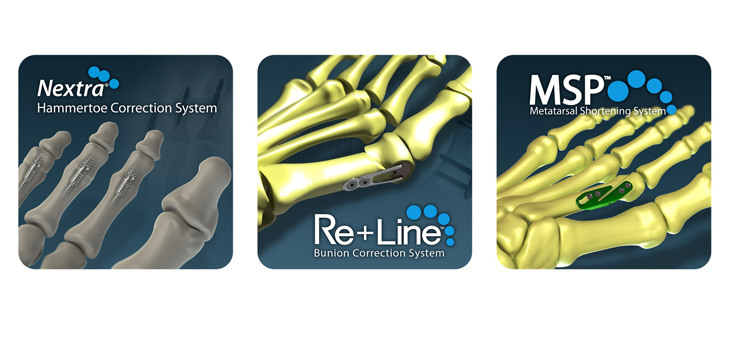
- The Nextra Hammertoe Correction System, which, according to the company, is the industry’s only adjustable two-piece hammertoe implant. This past May, Nextremity reported research results featured in The Journal of Foot and Ankle Surgery, showing that the Nextra Hammertoe system works better than the traditional Kirschner Wires (K-wires).
- The MSP Metatarsal Shortening System is a “first of its kind” osteotomy guide and implant in one. The company states the system’s “innovative design provides precision and stability” for metatarsal shortening procedures without plantar displacement. Nick Deeter, Nextremity’s CEO and chairman, told OTW last year that he believes that when patients hear that the shortening system provides them with reduced post-operative stiffness as well as no post-operative floating toe, they will help drive the decision to use this implant.
- The Re+Line Bunion Correction System, the company’s second product line, is a unique, low profile tension-band compression plate designed for performing precise, repeatable bunion correction surgery. Two years ago, the company told OTW that it was its goal that within a year, the correction system would be recognized as a unique solution for bunion surgery. The Re+Line plate’s 4-point fixation was designed to “provide superior stability with multiple osteotomy techniques. This is what forefoot surgeons require to achieve an excellent and enduring surgical outcome with minimum patient downtime. Re+Line will take its place side-by-side with the Nextra Hammertoe Correction System as industry leading implant systems in the hi-growth forefoot surgery market.”
- The Arcus Staple System is an arc-styled staple design that the company claims provides greater and more uniform compression than conventional staples. The system received 510(k) FDA clearance in mid-2015. The company said that testing has shown that the staple system “performs better at maintaining compression over time when compared to the competition.” The system is indicated for fixation of bone fractures, bone reconstruction, ligament, soft tissue and tendon. This includes, fixation of bone fragments or small bones fractures, as well as fracture management in the foot and hand. An application for a CE mark is pending.
Nextremity Solutions was co-founded by surgeons in 2010 in Warsaw, Indiana and is privately held.
Author
React:
Discussion
This is a fascinating development. In my practice we've seen similar outcomes with the revised protocol. The key differentiator seems to be patient selection criteria. Has anyone else noticed the correlation with BMI thresholds?
Great point. I'd push back slightly on the conclusion, the sample size in the cited study is too small to draw population-level inferences. That said, the directional signal is compelling and worth a larger RCT.
We implemented a similar approach last year. Early results are promising but we're still gathering 12-month follow-up data. Happy to share our protocol if anyone is interested.
Join the conversation
Orthopedic professionals are discussing this. Sign in and upgrade to read every comment and add your voice.