
Gloria Beim, M.D. Leads Team USA 2016 Paralymics in Rio
What Being an Olympic Doctor Is All About; Pittsburgh Declares Freddie Fu Day!; “Off” Switch for Pain
7 min read Premium comments
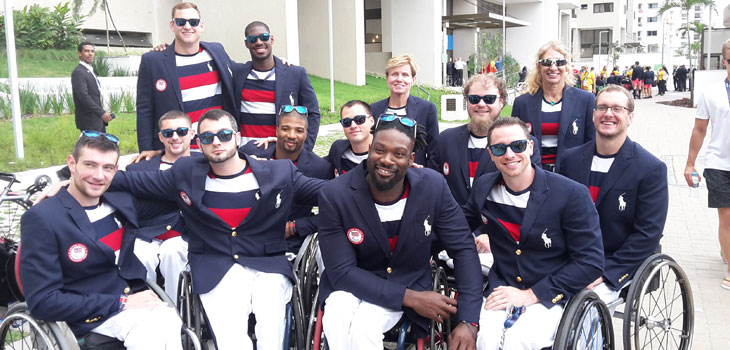
Gloria Beim, M.D. has been working with the U.S. Olympic Committee Sports Medicine team since she volunteered at the Olympic Training Center in Colorado Springs in 2001. She has been to three Olympics, two World University Games, a Pan Am Game, a Parapan Am Game. This is the fifth time that she has served as Chief Medical Officer for Team USA. This was her first Paralympics.
Discussing her recent experience in Rio, Dr. Beim told OTW, “Asked about a standout moment at the Paralympics, Dr. Beim said, “I’ve had the honor of marching in many Opening Ceremonies but for some reason, this one was the most emotional and exciting for me. I think it was because I was in so much awe of these Paralympians. All of them have overcome so many obstacles in life in addition to training as hard as any Olympian and exhibiting so much grace and passion in their sport. It was truly a humbling experience.
“A visually impaired athlete had been training and competing with a chronic injury which was not addressed properly for many years. Even though she was at the elite level in her sport, she did not have the resources available to her to evaluate her injury yet she did not let that stand in her way to make it to the top. I had the opportunity to work with her throughout the games and was able to make a diagnosis and get her on her way to treat the injury. She was incredibly happy and I know that she will return to her sport better than ever.
“I spent a lot of time getting to know the men’s wheelchair basketball team already a year before at the Parapan Am Games which is a Paralympic qualifier for many teams. I was asked by the team to sit on the bench at the Paralympics and felt the greatest honor doing so. One of the coaches called me ‘the most overqualified water girl on the planet, ’ but being a team player is how I have always been successful at these games. They made me feel like I was really a part of the team and part of their amazing family. When I heard our National Anthem at the Gold Medal Game, I could have filled a bucket with my tears of joy.”
Asked if she might have any advice to younger orthopedic surgeons who one day hope to work with these athletes, Dr. Beim commented to OTW, “Just remember that we are the ‘team behind the team.’ We are there to help the athletes in any way that we can so that they can focus on their competition. Whether it is treating an injury or an illness or carrying their bags through an airport, it is an honor to assist them in their quest for being the best that they can be. Being a team player is the secret and there is no task that should be considered ‘below your skill set.’ Remember, I was named ‘the most overqualified water girl on the planet’ and I will cherish that title forever!”
Freddie H. Fu, M.D. Day in Pittsburgh
With this latest recognition, there is hardly an award that he hasn’t won. Freddie H. Fu, M.D., the esteemed chief of orthopedic surgery at the University of Pittsburgh, has now received the ultimate honor from his adopted city—a day named after him.
The Council of the City of Pittsburgh officially proclaimed September 13, 2016 to be “Dr. Freddie Fu Day.”
Dr. Fu, the David Silver professor and chairman of the department of orthopedic surgery at the University of Pittsburgh School of Medicine, told OTW, “I have a great love for Pittsburgh, a city I first experienced as an immigrant and then as a citizen. All of my children were born here and we are a proud Pittsburgh family. I am grateful to the City Council for this recognition.”
Born and raised in Hong Kong, Freddie Fu later moved to the United States where he attended medical school at Dartmouth College, graduating summa cum laude in 1974. In 1977 he was awarded a medical degree from the University of Pittsburgh School of Medicine, then undertook a general surgery internship at Brown University. He then returned to the University of Pittsburgh for an orthopedic research fellowship and to complete his orthopedic residency training. In a testament to his unending stream of dedication and energy, Dr. Fu was an AO International Fellow at the Hannover Trauma Center in Germany and an arthroscopic surgery fellow in East Lansing, Michigan.
The only orthopedic surgeon to have a special day named after him—and the only Pittsburgh resident to be inducted in the Hall of Fame of the American Orthopedic Society for Sports Medicine (AOSSM)—Dr. Fu commented to OTW, “I have had chances to leave Pittsburgh, but I greatly enjoy the city and I wanted to stay and build a phenomenal program here at ‘Pitt.’ I think we have done that…and I could only do it because of the outstanding support from the administration.”
Dr. Fu has been honored with over 260 professional awards, many of which are due to his innovative work on anatomic anterior cruciate ligament (ACL) reconstruction, clinical outcomes, and the bioengineering of sports-related problems. He is a past president of the AOSSM and the International Society of Arthroscopy, Knee Surgery and Orthopedic Sports Medicine (ISAKOS).
Not content to “just” build a program, Dr. Fu decided to construct buildings. He was the primary driver of the Sports and Preventive Medicine Institute, designing and overseeing the construction of the $80 million University of Pittsburgh Medical Center Rooney Sports Complex.
“Years ago I started the first Pittsburgh marathon, I’ve taken care of dancers from the Pittsburgh Ballet Theatre, and I’m proud to have brought over 800 foreign fellows to the city over the years.”
As for his latest professional adventure, Dr. Fu says, “I just returned from Italy where I was the presidential speaker at a meeting of the Italian Orthopedic Society; they were kind enough to make me their first honorary member. Soon I will be off to Hong Kong where I will have the pleasure of speaking to the International Association for Dance Medicine and Science. While there I will also visit my alma mater, St. Paul’s College, which is the oldest high school in Hong Kong. I have been invited to speak in front of the school. My message to them will be, ‘love what you do, respect the past, embrace the future.’”
Pain? Hit the “Off” Switch
A new technology from Case Western University and Halyard Health may make it possible to “turn off” chronic or acute pain. The co-principal investigators on the project are Kevin Kilgore, M.D., a professor of Orthopedics in the university’s School of Medicine and at The MetroHealth System, and Niloy Bhadra, M.D., Ph.D. in Case Western Reserve’s Department of Biomedical Engineering.
Dr. Kilgore told OTW, “The unique aspect of our technology is that it is an electrical method for directly blocking nerve signals. We sometimes loosely call it an ‘electric lidocaine.’ However, unlike lidocaine and similar anesthetics, our electrical block can be turned on and off at will by either the clinician or patient. Also, you can ‘dose’ the nerve as much as you want—meaning that if you want to have a continuous block for days (or longer) you can do that. The electrical block doesn’t wear off after a few hours like a drug does.”
Asked about the challenges of identifying the specific nerve sending pain signals to the brain, Dr. Kilgore commented to OTW, “Actually, if the specific site of pain can be identified, it is relatively easy to identify the nerve or nerves that would need to be blocked in order to achieve pain relief. In cases of generalized chronic pain, identifying the source of the pain can be more difficult. But, for example, many types of headaches and facial pain can be relieved by targeting either the occipital nerve or the trigeminal nerve. Sciatica pain can be relieved by targeting the sciatic nerve. Generally, though, the difficulty lies in being able to specifically target, or block, specific parts of those nerves (specific nerve fibers) without blocking everything else. For example, if you block the whole sciatic nerve, you will temporarily paralyze the entire leg, so obviously that is undesirable. Part of our work on this joint project with Halyard is to refine our technique so that we can specifically block the fibers in the nerve we want to block while leaving the other fibers alone.
“We are really just getting started, but I expect that within a year we will know for certain whether our method will work well for acute (short/immediate) pain, such as after surgery. In a year we should be in a position to begin performing the testing that will allow us to start human tests. The early human tests will primarily focus on safety—we want to make sure we can use this for days to months without causing any damage to the nerves we are targeting. Once that safety is established—and I expect it will be—then we will be in a position to begin clinical trials.”
Author
React:
Discussion
This is a fascinating development. In my practice we've seen similar outcomes with the revised protocol. The key differentiator seems to be patient selection criteria. Has anyone else noticed the correlation with BMI thresholds?
Great point. I'd push back slightly on the conclusion, the sample size in the cited study is too small to draw population-level inferences. That said, the directional signal is compelling and worth a larger RCT.
We implemented a similar approach last year. Early results are promising but we're still gathering 12-month follow-up data. Happy to share our protocol if anyone is interested.
Join the conversation
Orthopedic professionals are discussing this. Sign in and upgrade to read every comment and add your voice.