
German-based joimax GmbH launched two new endoscopic spine products at Eurospine 2016 taking place in Berlin, Germany, from October 5 to October 7, 2016.
New Endoscopic Tools From joimax at Eurospine 2016
2 min read Premium comments
Secondary
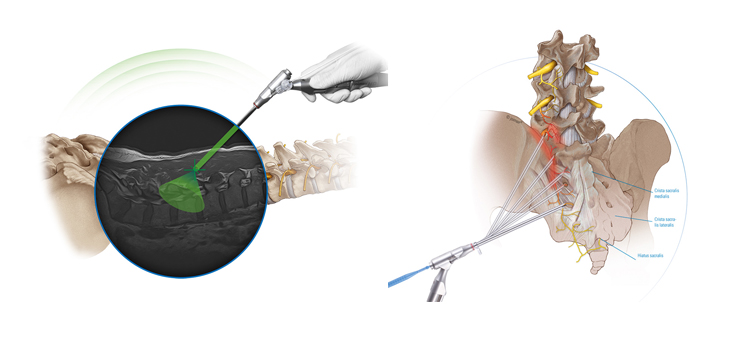
The two products are the MultiZYTE SI Endoscopic Sacroiliac Joint Therapy Set and the Intracs Intraoperative Navigation Tracking & Control System.
The sacroiliac joint therapy set is developed for the treatment of the sacroiliac joint syndrome (SIJS), which the company says has been rediscovered as a major back pain generator. This kind of pain is commonly felt in the lower back, the gluteal region, the hip and thigh and can even radiate into the leg and foot.
Until the 1930s, the company says the SI joint was the main reason for low back pain, but since 1934 the focus has been on disc herniation. According to recent studies, 15% to 25% of all low back pain is caused by the SI joint and up to 43% in patients having undergone lumbosacral fusion.
The Intracs navigation tracking and control system was developed in cooperation between joimax in Karlsruhe and fiagon GmbH located in Berlin.
With the Intracs system, joimax instruments can be navigated directly at the tip using fiagon’s “chip at the tip” technology which allows tracking of instruments with a diameter in the 1mm range. The Intracs navigation and monitor unit is integrated in the joimax Endoscopic Tower and all necessary tools are tailored for the TESSYS (transforaminal) and iLESSYS (interlaminar) procedures as well as for minimally invasive stabilization procedures, like EndoLIF and Percusys. The main features of the Intracs system are needle navigation through Vector-Tip-Target processing tools, the merging of 2D X-rays with 3D images of a patient’s CT or MRI scans, and the constant orientation control of any endoscope used in joimax procedures.
Wolfgang Ries, CEO and founder of joimax, said these new developments will allow the company to drive adoption rates to “meet new heights.” Navigation is now “faster, safer and more accurate than ever before, ” using an electromagnetic (EM) field. Radiation exposure for both, patients and surgeons will be “significantly reduced.”
“Additionally, ” said Ries, the learning curve for all spinal endoscopic procedures offered by joimax will now be “significantly reduced and the rapid expansion of all these techniques is now well layed-out [sic].”
Author
React:
Discussion
This is a fascinating development. In my practice we've seen similar outcomes with the revised protocol. The key differentiator seems to be patient selection criteria. Has anyone else noticed the correlation with BMI thresholds?
Great point. I'd push back slightly on the conclusion, the sample size in the cited study is too small to draw population-level inferences. That said, the directional signal is compelling and worth a larger RCT.
We implemented a similar approach last year. Early results are promising but we're still gathering 12-month follow-up data. Happy to share our protocol if anyone is interested.
Join the conversation
Orthopedic professionals are discussing this. Sign in and upgrade to read every comment and add your voice.