
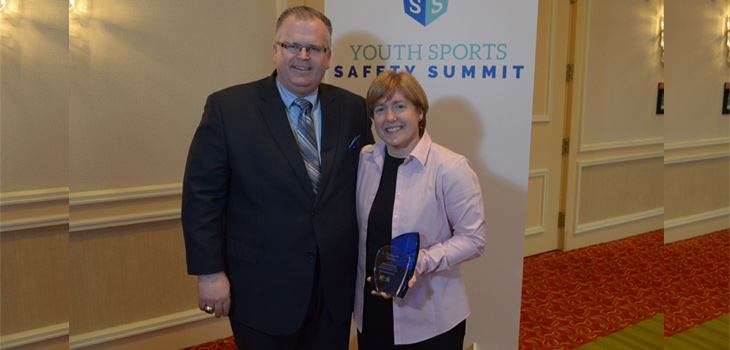
The National Athletic Trainers’ Association (NATA) has announced the opening of nominations for the third annual Youth Sports Safety Ambassador Awards. Nominations will be accepted now through December 2, 2016. According to the October 14, 2016 news release, the awards recognize individuals and/or entities that have made a significant contribution to advancing athlete safety based on one of two criteria:
NATA Opens Youth Sports Safety Ambassador Nominations
2 min read Premium comments
Secondary
- By providing exemplary youth sports safety protocols and care that set a precedent and/or model that others can follow.
- By advancing youth sports safety in one of the following areas: provision of appropriate medical care, research, policy change and/or resource allocation.
“NATA champions the significant contributions of leaders in youth sports safety research, education and legislation, ” said NATA President Scott Sailor, Ed.D., A.T.C. “We are proud to honor some of the best in their field with the Youth Sports Safety Ambassador Awards and know their advances can help save lives.”
The awards will be presented at the eighth Youth Sports Safety Summit on March 7, 2017, in Indianapolis. The Summit is hosted by NATA and the Youth Sports Safety Alliance.
Previous award recipients:
Dawn Comstock, Ph.D., associate professor, Colorado School of Public Health, is one of the country’s leading high school injury surveillance published researchers whose studies have influenced policy change and best practices.
Dallas (Texas) Independent School District hired one or more full-time athletic trainers for all high schools in the district, reinforcing its commitment to athlete safety.
The NFL Foundation’s numerous efforts include the Athletic Trainer Grant Initiative, which provided matching grants to NFL clubs to fund athletic trainers in underserved middle schools, high schools and youth leagues nationwide.
Project ADAM (Automated Defibrillators in Adam’s Memory) works with high schools and communities to prevent sudden cardiac arrest through education and lifesaving programs and to assist schools in acquiring AEDs.
U.S. Rep. Bill Pascrell, Jr. (NJ-09) plays a significant leadership role in the U.S. Congress in advocating for student athlete safety and is dedicated to educating others about the dangers of traumatic brain injury (TBI).
USA Football has an innovative and comprehensive approach to teaching and playing the sport, addressing how coaches are trained, athletes are taught, parents are informed and safety is handled.
Dr. Sailor told OTW, “NATA champions the significant contributions of leaders in youth sports safety research, education and legislation. We are proud to honor some of the best in their field with the Youth Sports Safety Ambassador Awards and know their advances can help save lives.”
React:
Discussion
This is a fascinating development. In my practice we've seen similar outcomes with the revised protocol. The key differentiator seems to be patient selection criteria. Has anyone else noticed the correlation with BMI thresholds?
Great point. I'd push back slightly on the conclusion, the sample size in the cited study is too small to draw population-level inferences. That said, the directional signal is compelling and worth a larger RCT.
We implemented a similar approach last year. Early results are promising but we're still gathering 12-month follow-up data. Happy to share our protocol if anyone is interested.
Join the conversation
Orthopedic professionals are discussing this. Sign in and upgrade to read every comment and add your voice.