
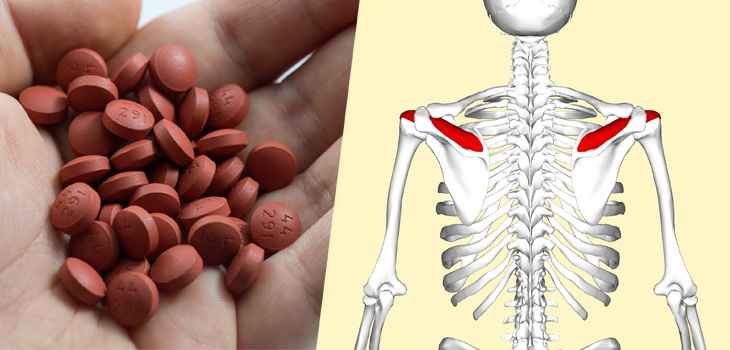
A new study undertaken at the McKay Orthopaedic Research Laboratory at the University of Pennsylvania has found that ibuprofen does not hamper the supraspinatus tendon’s ability to adapt to exercise, but that one should keep an eye out for a decrease in muscle growth. The research team was led by Louis J. Soslowsky, Ph.D., vice chair for Research in the Department of Orthopaedic Surgery at the University of Pennsylvania.
Ibuprofen’s Effects on Healing
1 min read Premium comments
Secondary
He told OTW, “There has been a lot of interest from our lab and others on the role of non-steroidal anti-inflammatory drugs (NSAIDs) on tissue injury and repair. However, ibuprofen, the most common NSAID taken, is commonly used by athletes prophylactically, though the effect on relevant tissues is unknown. We developed an animal model of exercise we could use to address this.”
“We divided 167 rats into either exercise or cage activity groups; we also separated them as ‘acute’ (a single bout of exercise followed by 24 hours of rest) and ‘chronic’ (2 or 8 weeks of repeated exercise) response times. Half of the rats received ibuprofen.
“Chronic administration of ibuprofen does not adversely affect tendon properties, but does seem to decrease muscle growth. This is important information for counseling young athletes. The above knowledge may change how doctors and sports trainers advise their patients and student-athletes.”
React:
Discussion
This is a fascinating development. In my practice we've seen similar outcomes with the revised protocol. The key differentiator seems to be patient selection criteria. Has anyone else noticed the correlation with BMI thresholds?
Great point. I'd push back slightly on the conclusion, the sample size in the cited study is too small to draw population-level inferences. That said, the directional signal is compelling and worth a larger RCT.
We implemented a similar approach last year. Early results are promising but we're still gathering 12-month follow-up data. Happy to share our protocol if anyone is interested.
Join the conversation
Orthopedic professionals are discussing this. Sign in and upgrade to read every comment and add your voice.