
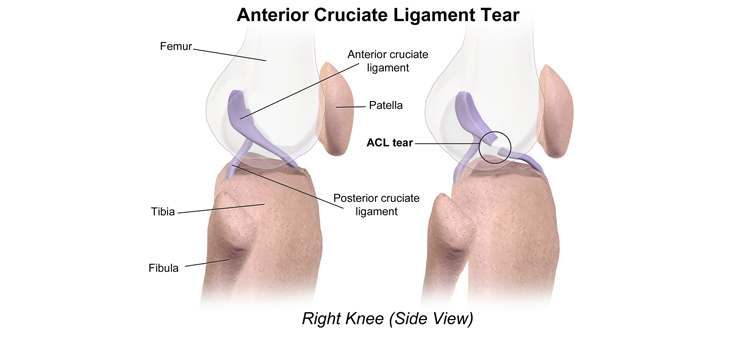
Research performed at the University of Delaware and funded by the National Institute of Arthritis Musculoskeletal and Skin Diseases and the National Institutes of Health has shown how osteoarthritis (OA) can set in following anterior cruciate ligament (ACL) injury.
How OA Can Follow ACL Injury
1 min read Premium comments
Secondary
According to the October 17, 2016 news release, “For the study, 30 athletes underwent gait analysis 6 months after ACL reconstruction. It was found that the knee adduction moment (generated by the combination of the ground reaction force that passes medial to the center of the knee joint, and the perpendicular distance of this force from the center of the joint) has a large influence on joint contact forces after surgery. This may provide a critical clue to understanding the mechanical pathway of post-traumatic osteoarthritis after ACL injury. Additional research is needed to identify other driving factors of joint loading in ACL-injured limbs and to help develop new therapies to prevent post-traumatic osteoarthritis.”
Lead author Elizabeth Wellsandt, Ph. D., now at the of University of Nebraska Medical Center told OTW, “Most surgeons think that joint overloading phenomena are the big players in the development of PTOA [post-traumatic osteoarthritis]. We have shown previously that the ACL injured and reconstructed knee is underloaded from before surgery to six months after surgery. This study shows the components of joint biomechanics that are underloaded and likely influence the breakdown of articular cartilage and the development of PTOA after ACLR [anterior cruciate ligament reconstruction].”
“Normal movement patterns can be restored through rehabilitation, and provide potential for post-traumatic osteoarthritis to be prevented after ACL injury. Many individuals continue to demonstrate abnormal movement patterns nine and even twelve months, after ACL reconstruction. Normalizing these movement patterns before returning to prior levels of activities may be required for the knee’s articular cartilage to safely withstand the demands of sports, leisure, and occupational activities and minimize the development of early osteoarthritis.”
Author
React:
Discussion
This is a fascinating development. In my practice we've seen similar outcomes with the revised protocol. The key differentiator seems to be patient selection criteria. Has anyone else noticed the correlation with BMI thresholds?
Great point. I'd push back slightly on the conclusion, the sample size in the cited study is too small to draw population-level inferences. That said, the directional signal is compelling and worth a larger RCT.
We implemented a similar approach last year. Early results are promising but we're still gathering 12-month follow-up data. Happy to share our protocol if anyone is interested.
Join the conversation
Orthopedic professionals are discussing this. Sign in and upgrade to read every comment and add your voice.