
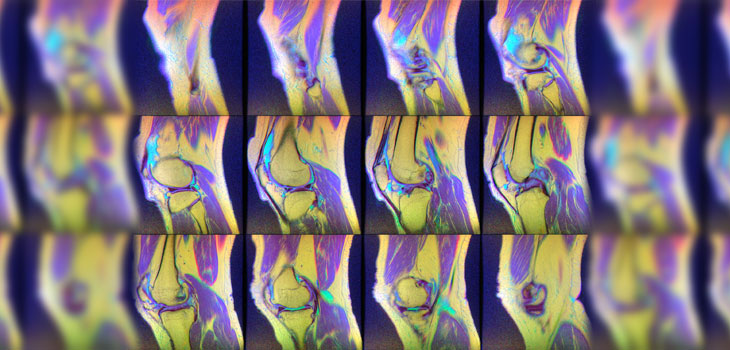
ACL [anterior cruciate ligament] and meniscus tears are, if not serious, certainly painful. And if your patient is a professional athlete, they can mean the loss of whole seasons at a time.
Here’s How Rare Meniscus Cartilage Repair Is
2 min read Premium comments
Secondary
There are lots of reasons for injuries and insults to joint cartilage. Age, for sure. But traumas from sports, yard work and occupational hazards (we’re talking about you in the hospital!) all pull and tear at ligaments and cartilage.
Unfortunately, as this new data from the University of Copenhagen indicates, those injuries appear to pile up and the cartilage simply doesn’t appear to have the ability regenerate itself.
Rheumatologist Michael Kjaer, M.D., DMSc came up with a novel material to measure the existence or lack thereof of cartilage repair—a radioactive isotope of carbon called carbon-14.
Because of years and years of nuclear weapons testing, the levels of carbon-14 have varied greatly in the atmosphere. By examining the carbons present in cartilage Dr. Kjaer and his team hoped to be able to accurately measure the rate of cartilage growth or regeneration.
His hypothesis was that if cartilage was being replaced, then the levels of carbon-14 in the collagen should be similar to the current atmospheric levels. If, on the other hand, cartilage had not grown or regenerated, then the level would be aligned with the level in the atmosphere at the time of last growth, explained Sarah Haire, a writer for The Tiger.
So Dr. Kjaer studied this phenomenon in patients who had some type of cartilaginous knee problems and were at such an advanced stage of injury that they were candidates for knee replacement.
After measuring the levels of carbon-14, Dr. Kjaer and his team found that there was essentially no change in carbon-14 levels in each individual’s cartilage from levels that were likely to have existed when these patients were reaching knee maturity—roughly between the ages of 8 to 13 years.
The data clearly shows that, despite years of deterioration, the cartilage never regenerated after reaching maturity.
There are several implications from this work but probably the most valid is that cartilage repair—whether by nature or by intervention—is and will likely remain one of the more difficult regenerative tissue problems orthopedists confront.
Author
React:
Discussion
This is a fascinating development. In my practice we've seen similar outcomes with the revised protocol. The key differentiator seems to be patient selection criteria. Has anyone else noticed the correlation with BMI thresholds?
Great point. I'd push back slightly on the conclusion, the sample size in the cited study is too small to draw population-level inferences. That said, the directional signal is compelling and worth a larger RCT.
We implemented a similar approach last year. Early results are promising but we're still gathering 12-month follow-up data. Happy to share our protocol if anyone is interested.
Join the conversation
Orthopedic professionals are discussing this. Sign in and upgrade to read every comment and add your voice.