
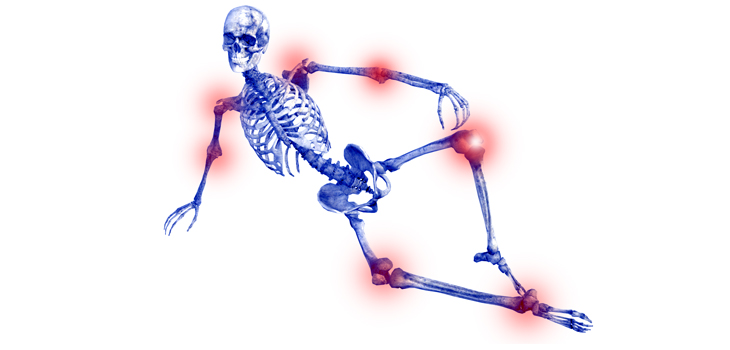
Having knee pain can also mean that you have “outside the knee” pain. Researchers have not had the full picture of the pain distribution and reasons for the pain, however. New research involving the Boston University School of Medicine, the University of Alabama School of Medicine, the University of California, San Francisco, and the Boston University School of Public Health has found that those with knee pain can indeed have pain in other joints, and that this pain doesn’t seem to follow a pattern.
Found: New Info on Knee Pain Distribution
1 min read Premium comments
Secondary
David T. Felson, M.D., M.P.H. is professor of Medicine and Public Health at the Boston University School of Medicine. He told OTW, “We used the Multicenter Osteoarthritis Study and the Osteoarthritis Initiative and followed nearly 3, 500 individuals who were 50-79 years who were at high risk of knee osteoarthritis (OA).”
“We looked into the distribution of joint complaints that develop in persons with knee pain and knee osteoarthritis. Many have suggested that adjacent joints (hips/ankles) are often affected because of biomechanical changes in gait due to knee pain. Our study found that persons with knee pain had more pain in other joints but that the distribution of that pain was random and not necessarily predominantly in adjacent joints (either ipsi or contralateral). These other symptoms suggest that biomechanical adaptations to knee pain are individualized but that the other pain that develops may well be due to changes in activities that spare loading to the affected knee. Orthopedists should take these complaints as possible evidence that the knee may be causing more problems that just in the knee.”
React:
Discussion
This is a fascinating development. In my practice we've seen similar outcomes with the revised protocol. The key differentiator seems to be patient selection criteria. Has anyone else noticed the correlation with BMI thresholds?
Great point. I'd push back slightly on the conclusion, the sample size in the cited study is too small to draw population-level inferences. That said, the directional signal is compelling and worth a larger RCT.
We implemented a similar approach last year. Early results are promising but we're still gathering 12-month follow-up data. Happy to share our protocol if anyone is interested.
Join the conversation
Orthopedic professionals are discussing this. Sign in and upgrade to read every comment and add your voice.