
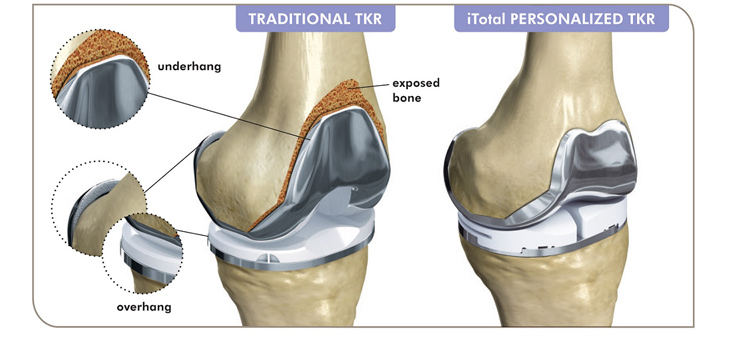
New research indicates that the ConforMIS iTotal CR performed better than traditional off-the-shelf implants. The study, already published online, has been accepted for publication in the The Journal of Arthroplasty.
ConforMIS iTotal CR Outperformed Off-the-Shelf Implants
1 min read Premium comments
Secondary
“I have been using ConforMIS customized knee replacements for over five years and this study reinforces the results that I have observed in my patients that have received a ConforMIS iTotal CR implant, ” said William Kurtz, M.D., a fellowship-trained surgeon at Saint Thomas Midtown Hospital in Nashville, Tennessee, in the October 17, 2016 news release. “In my experience, the ConforMIS knee system typically gives my patients a better outcome than a standard off-the-shelf knee and a better opportunity to get back to doing the activities they love.”
According to the news release, “In this study, researchers at the University of Tennessee’s Center for Musculoskeletal Research assessed the kinematics of 38 patients (24 patients with a ConforMIS iTotal CR implant and 14 patients with a leading off-the-shelf implant) all implanted by the same surgeon. Using state-of-the-art mobile fluoroscopy, researchers were able to analyze tibiofemoral kinematics, or motion patterns of the knee, and to evaluate each patient for weight-bearing range-of-motion, femorotibial translation, femorotibial axial rotation, and condylar liftoff during a weight bearing deep knee bend and a rise from a seated position.”
Dr. Kurtz told OTW, “My patients have greatly benefited from the normal knee kinematics that the ConforMIS knee offers. The ConforMIS knee system allows me to accurately measure and restore the patient’s unique anatomy and varus joint line, which surgeons just can’t accomplish with any other knee system today.”
“Patients really feel more stable with their custom knee replacements especially when they do activities like bending or walking down stairs which some patient with off-the-shelf knee replacements have difficulty with due to mid-flexion instability.”
Author
React:
Discussion
This is a fascinating development. In my practice we've seen similar outcomes with the revised protocol. The key differentiator seems to be patient selection criteria. Has anyone else noticed the correlation with BMI thresholds?
Great point. I'd push back slightly on the conclusion, the sample size in the cited study is too small to draw population-level inferences. That said, the directional signal is compelling and worth a larger RCT.
We implemented a similar approach last year. Early results are promising but we're still gathering 12-month follow-up data. Happy to share our protocol if anyone is interested.
Join the conversation
Orthopedic professionals are discussing this. Sign in and upgrade to read every comment and add your voice.