
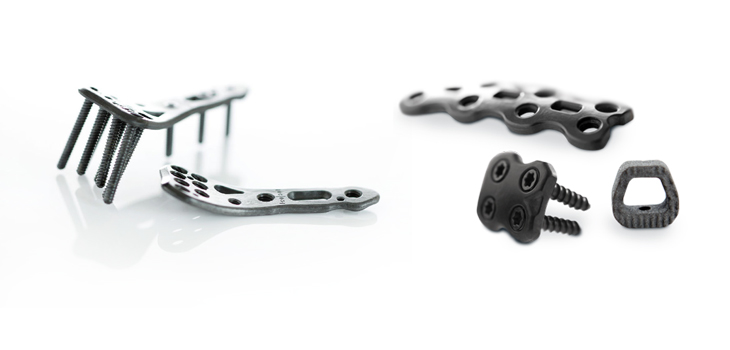
A medical device company based in Altstätten, Switzerland, that spells its name in lower-case type is icotec AG. The company develops and manufactures non-metallic carbon/PEEK composite medical devices under the brand name BlackArmor. Its carbon/PEEK material boosts a 15-year and 20, 000 implantation clinical track record in spinal and fracture surgical care, according to the company’s press release.
Carbon Reinforced PEEK vs Metal Implants
1 min read Premium comments
Secondary
As the manufacturer explains, BlackArmor is a combination of continuous, high-strength carbon fiber reinforced PEEK and the company’s composite flow molding (CFM) process. The result, say its designers, is a medical device with an interwoven 3D fiber architecture that provides unmatched strength and endurance. icotec’s technology is useful for complex designs such as pedicle screws, vertebral body replacement devices or supplemental fixation devices, such as anatomical bone plates.
They claim that the combination of mechanical strength and non-metallic properties make BlackArmor ideally suited for the treatment of spinal tumors.
Radiation therapy plays a major role in the treatment of spinal tumors. Radiologists rely on accurate CT images. The presence of metal spinal implants makes it more difficult to delineate anatomic structures during radiation therapy planning, according to the release. It also suggests that metal spinal implants may also shield tumor cells from the radiation.
BlackArmor is radiolucent in all diagnostic imaging modes (MRI, CT and X-ray) and will therefore not create imaging artifacts. The non-metallic nature of the BlackArmor material minimizes the risk for patients where metal allergies are a concern. Orthopedic implants manufactured from BlackArmor carbon/PEEK material were approved for CE-mark in 2000 and received FDA clearance in 2005.
Author
React:
Discussion
This is a fascinating development. In my practice we've seen similar outcomes with the revised protocol. The key differentiator seems to be patient selection criteria. Has anyone else noticed the correlation with BMI thresholds?
Great point. I'd push back slightly on the conclusion, the sample size in the cited study is too small to draw population-level inferences. That said, the directional signal is compelling and worth a larger RCT.
We implemented a similar approach last year. Early results are promising but we're still gathering 12-month follow-up data. Happy to share our protocol if anyone is interested.
Join the conversation
Orthopedic professionals are discussing this. Sign in and upgrade to read every comment and add your voice.